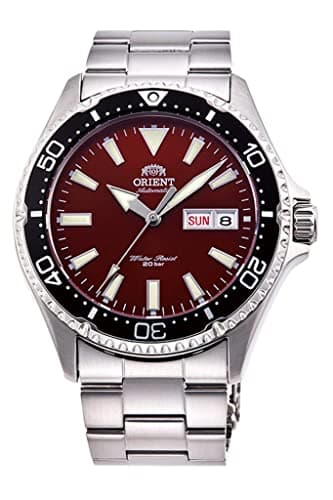
How an automatic actually gets its power
A weighted rotor swings as your wrist moves and winds the mainspring. The spring stores energy and releases it through the gear train. When the stored energy runs out, the watch stops.
Full wind gives a stated power reserve - typically 38 to 50 hours on most Japanese and Swiss movements, and up to 80 hours on something like a Powermatic 80 or Hamilton’s H-50.
That number is the key to diagnosing almost every stopping problem.
Cause 1: you are not moving enough
By far the most common, and not a fault. Desk work generates very little wrist motion. A watch worn eight hours at a keyboard may gain less power than it uses.
Fix: hand-wind it twenty to thirty turns in the morning if your watch supports it. Seiko’s 4R36 and Orient’s in-house calibers both do. The older Seiko 7S26 does not, which is the main practical reason to prefer the newer movement.
You cannot overwind an automatic - there is a slipping clutch on the mainspring specifically to prevent it.
Cause 2: you took it off overnight
Also not a fault. A watch with a 40-hour reserve, taken off at 10pm on Friday after a day of light wear, is genuinely likely to be stopped by Sunday morning.
Fix: wear it more, or hand-wind it before putting it on. A winder is overkill for a plain three-hander and adds wear to the movement for no benefit.
Cause 3: the rotor is not winding efficiently
If the watch stops despite active wear, the rotor bearing may be worn or the winding mechanism may need attention. On older or heavily-worn watches this is common.
Test: wind it fully by hand, take it off, and time how long it runs. If it runs close to its stated reserve, the movement is fine and the rotor or your activity level is the issue. If it stops well short, go to cause four.
Cause 4: it needs a service
A dramatically shortened power reserve means the lubricants have degraded and friction has increased throughout the gear train. That is the clearest signal a watch needs servicing, and it is a better indicator than any calendar interval.
Accuracy drifting away from where it used to sit is the other one. A watch that has always run +10 seconds a day and is now running +40 is telling you something.
The things that are not the cause
Magnetism causes accuracy problems - usually running very fast - rather than stopping. It is fixed in minutes with a demagnetizer.
Cold thickens lubricants and can affect accuracy; it does not usually stop a healthy watch.
Position matters for accuracy, not for stopping. Storing a watch dial-up overnight is a timekeeping trick, not a power one.
The quick diagnostic
Wind it fully by hand. Set it. Take it off. Time it until it stops.
Close to the stated reserve - the watch is healthy and you need to wear or wind it more. Well short - book a service. That is the whole test, and it costs nothing.