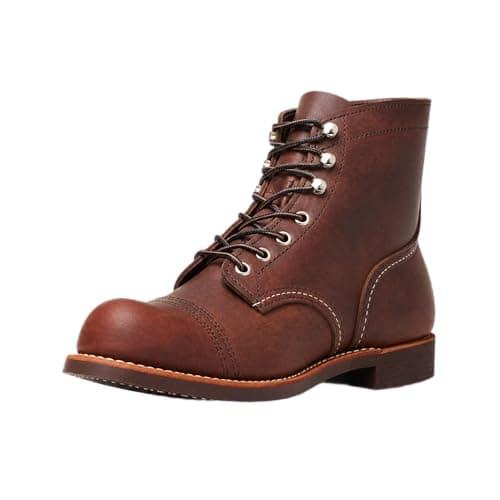
The anatomy, from the bottom up
From the ground: outsole, the rubber or leather you walk on. Midsole, usually leather, giving structure. Welt, a strip of leather running around the boot's perimeter. Insole, with a canvas or leather rib on its underside. Upper, the part you see.
The upper and the welt are stitched to the insole rib. Then the outsole is stitched to the welt. Two separate seams - and that is the entire trick, because the second seam can be cut and redone without touching the first.
Why it makes a boot rebuildable
In a cemented boot, the outsole is glued directly to the upper. There is no intermediate layer, so removing the sole means pulling at the upper, and re-gluing never holds as well as the factory bond did. A direct-attach boot is worse still: the polyurethane is molded onto the upper under pressure, so there is no separation line at all.
With a welt, the cobbler cuts the outsole stitching only. The upper, insole and welt stay exactly as they were. A new midsole and outsole go on, the welt is re-stitched, and the boot is structurally new from the welt down.
How to spot one in a shop
Turn the boot over and look at the edge. A welted boot shows a visible leather strip around the perimeter between the upper and the outsole, with a line of stitching running through it. Press a fingernail into it: it is leather, and it is a separate layer.
Be aware that some cemented boots have a decorative fake stitch molded into the rubber midsole to imitate this. The tell is that the fake stitch is part of the rubber rather than passing through a separate leather layer, and it usually runs perfectly evenly in a way hand or machine stitching does not.
Storm welt and the other variants
A storm welt has a raised lip on the inner edge that presses against the upper and keeps water out of the join. Thorogood uses one. It is marginally better in the wet and marginally harder to resole neatly.
Stitchdown flares the upper outward and stitches it directly to the midsole, with no separate welt strip. Danner builds this way. It is equally repairable and gives a wider platform.
Blake stitches the outsole straight through to the insole. It makes a sleeker, more flexible shoe and needs a Blake machine to resole, which fewer shops have.
The honest downsides
A welted boot is heavier, stiffer and slower to break in than a cemented one, because there are more layers and a leather midsole that has to compress to your foot. That is not a flaw in the construction - it is the construction - and it is why cemented boots dominate the market.
The welt seam is also the main route water takes into a boot. Keeping that line waxed is the single highest-value five minutes of maintenance a welted boot gets.
What it does not tell you
A welt says nothing about leather quality. A boot can be perfectly welted and built from thin, corrected-grain hide that cracks in three years, at which point the repairable sole is irrelevant. Check the construction first, then check the leather - in that order, because the first one is binary and the second one is a spectrum.