Fabric weight is the whole durability story
Work trousers fail by abrasion, and abrasion resistance scales with fabric weight. Carhartt firm duck is 12oz cotton canvas; Duluth’s Fire Hose is comparable. A standard pair of jeans is around 12-14oz denim but woven more loosely, and a poly-cotton twill like the Dickies 874 is considerably lighter.
That ordering holds in practice. Heavy canvas trousers last years in trade use; light twill lasts a season. The cost is that 12oz canvas is genuinely miserable for the first month - people compare it to cardboard and they are not exaggerating.
The elastane trade, stated plainly
Stretch work trousers - Carhartt’s Rugged Flex, most modern “flex” lines - are far more comfortable for crouching, climbing and kneeling. The comfort is real and worth something.
Elastane also degrades on its own, from heat, UV and repeated stretching, independent of how much abrasion the trouser sees. That means a stretch trouser has a built-in decay curve that pure cotton does not. Three to five years rather than ten.
This is a legitimate choice - spending a decade crouching in cardboard has its own cost - but it should be a choice rather than a surprise in year four.
The two construction details that decide survival
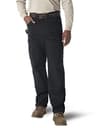
The gusseted crotch. Four seams meeting at a point is a stress concentration, and it is where work trousers split. A diamond gusset distributes that load. Wrangler’s Riggs line has one; many cheaper trousers do not. It costs the manufacturer almost nothing.
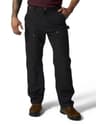
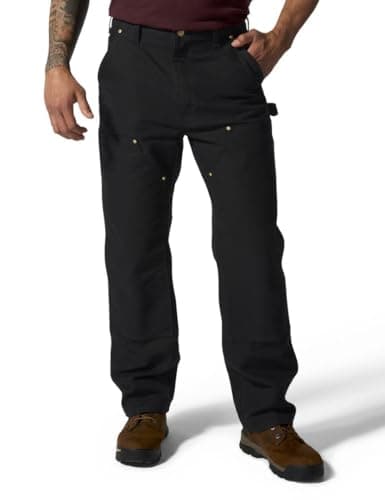
The double front. A second layer of canvas over the knee, which is where kneeling destroys trousers. It can be patched repeatedly - and it is the main reason a double-front Carhartt outlives a plain one by years rather than months.
The warranty, which will not help you
Carhartt publishes a limited warranty covering defects in materials and workmanship. It explicitly does not cover damage from normal wear and tear, including zippers and other hardware, nor misuse, neglect or alterations.
Dickies publishes roughly one year against manufacturing faults.
Neither will replace trousers you wore out, which is how trousers end. Buy on the fabric and the construction, and treat the warranty as covering the unlikely case where a pair arrives made wrong.
Repairability is unusually good here
Heavy cotton canvas takes a machine patch indefinitely, and a double-front knee can be re-patched several times over. A blown-out crotch can be re-gusseted. Pockets can be replaced.
A sewing machine and an hour turns a two-year trouser into a six-year one, and it is the single highest-leverage skill in this hub. It is also why we rate heavy canvas above stretch even where comfort suffers: stretch fabric is much harder to repair cleanly.