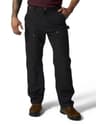
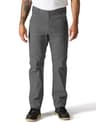
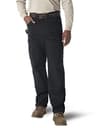
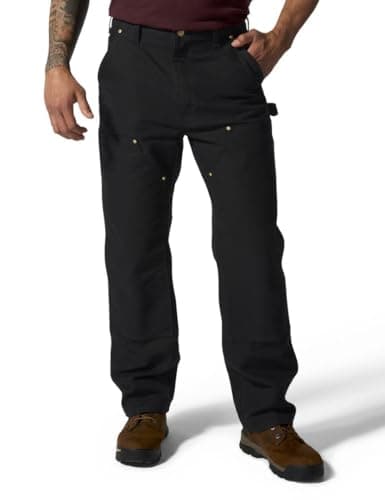
For work trousers you intend to keep, Carhartt wins: the 12oz firm-hand cotton duck with double-front knees is the most durable fabric in this comparison and it can be patched repeatedly. Dickies 874 is the better buy if you want a decent work trouser cheaply and are happy to replace it - the poly-cotton twill is lighter, softer immediately, more dimensionally stable, and wears through sooner. Neither brand publishes anything like a lifetime warranty.
The fabric is the entire argument
Carhartt’s firm-hand duck is a heavy, tightly woven 100% cotton canvas. Heavy cotton has two properties that matter here: it abrades slowly, and it takes a patch. A machine patch on canvas becomes part of the garment, and the double-front knee panels on the B01 can be re-patched again and again - which is why you still see Carhartt dungarees in service with three generations of repair on them.
Dickies 874 is a poly-cotton twill with a permanent crease. The polyester makes it lighter, faster drying, dimensionally stable through hot washes, and resistant to the wrinkling that makes cotton look scruffy. It also means a tear propagates faster than it does in canvas, and a patch sits on the fabric rather than becoming it.
Carhartt’s Rugged Flex is a cotton-elastane canvas - the answer to the most common complaint about duck, which is that it is stiff and does not move. You trade some repairability for it: stretch fabric is harder to patch cleanly, because the patch does not stretch.
Wrangler RIGGS ripstop is the outlier worth knowing about. Ripstop is woven with a reinforcing grid specifically so that a tear stays local, which makes it the most repair-friendly light fabric here even though it is the lightest.
What each brand actually warrants
This is the part most comparisons skip, and on this site it is the part we lead with.
- Carhartt: a limited warranty covering defects in materials and workmanship, explicitly not normal wear and tear. A blown seam in month two is a claim; a worn-through knee in year three is not.
- Dickies: products typically carry a one-year warranty against manufacturing faults, with some retail channels listing two years.
- Wrangler RIGGS: no published warranty terms we could find.
So neither brand is sold on a durability promise. Both are sold on fabric, and the fabric claims are the ones you can actually verify by looking at the weight and the weave.
Comfort, honestly
Dickies 874 is comfortable the moment you put it on. Firm-hand duck is not: it is stiff enough that the first week is a genuine adjustment and it takes a month or more of wear and washing before it drapes. Anyone who tells you the break-in is imaginary has not worn 12oz duck in August.
That break-in is also what the durability is made of - the fabric is stiff because it is dense, and it is dense because it resists abrasion. If you want the resistance without the stiffness, Rugged Flex is the compromise Carhartt built for exactly that complaint, and the Duluth Fire Hose canvas covered in our Carhartt versus Duluth comparison is the other mainstream attempt at it.
Fit and cut
The 874 is a straight-leg work trouser with a dress-trouser silhouette, which is why it escaped into general wardrobes decades ago. It is the easiest garment here to wear somewhere that is not a worksite.
The Carhartt dungarees are cut for working: higher rise, roomier seat and thigh, straight leg over a boot. The double-front models add a layer across the knee that you feel when you kneel - which is the point - and that bulk is the main reason some people dislike them. The RIGGS Ranger sits in between, with a gusseted crotch and the most thought-through pocket layout of the four.
The ten-year sum
We do not print prices here - the live price sits on each buy button - but the structure of the arithmetic is stable regardless of what they cost this week.
A pair of 874s costs roughly a third of a pair of double-front duck dungarees. If the duck lasts more than three times as long, it is cheaper per year, and in hard trade use with repairs it comfortably does. If you wear work trousers for weekend jobs rather than daily work, nothing wears out, both last essentially forever, and the 874 is the better buy by default.
The other variable is repair. Canvas rewards it and twill tolerates it. If you will never sew or pay someone to, the durability advantage of duck shrinks to the fabric alone and the gap narrows considerably.
Which to buy
Buy Carhartt firm-hand duck if you work in them most days, you kneel, and you will patch them. Buy Dickies 874 if you want a good trouser cheaply, you want it comfortable today, or you need something that survives a hot wash without shrinking. Buy Rugged Flex Rigby if duck has defeated you on mobility before, and the RIGGS Ranger if what you actually needed was pockets. Our work pants roundup ranks all four against the Duluth Fire Hose canvas as well.
Washing, shrinkage and the mistake that ruins duck
Untreated cotton duck shrinks on its first hot wash, which is why the standard advice is to wash cold and hang dry, and to buy with that in mind. Poly-cotton twill like the 874 is far more dimensionally stable through a hot cycle, which is a genuine practical advantage of a blend and the reason the 874 survives institutional laundries.
The mistake that actually ruins heavy canvas is a tumble dryer on high heat, repeatedly. It shrinks the weave, stiffens the fabric and sets creases that then become wear lines - and a wear line in canvas is where it will eventually split. Cold wash, hang dry, and accept that duck looks creased. That is what it looks like.
The other habit worth forming is patching early. A hole the size of a coin is a ten-minute machine repair; the same hole after a month of kneeling is a knee panel. A sewing machine and an hour is the difference between a two-year trouser and a six-year one, which is the single highest-leverage skill in this part of the site.