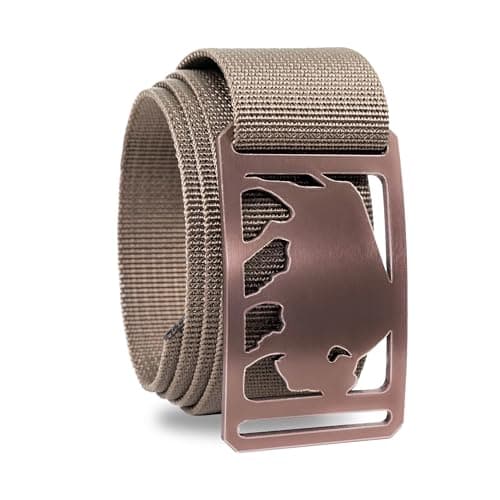
The belt to buy once is the GRIP6 nylon web belt. It has no stitching and no holes - the two places belts fail - GRIP6 publishes an unlimited lifetime warranty under which it will refund, repair or replace, and the buckle and strap are sold as separate components, so you replace a half rather than a belt. If it has to be leather, the Hanks Everyday Belt is the answer: a single thickness of full-grain hide with a screw-on roller buckle.
Belts fail in three places
It is a strap and a buckle, so the list of possible failures is short, and knowing it is most of the buying decision.
- The glue line. Most leather belts are two or three layers of split or bonded leather glued together with a line of stitching round the edge. The adhesive fails, the layers separate, and the belt folds over itself. Nothing can be done.
- The hole you always use. A buckle pin loads one point of leather every day. On a thin strap that hole stretches into a slot and eventually tears.
- The buckle. Plated buckles lose their plating; folded-metal buckles bend. On a riveted or sewn-on buckle, that ends the belt even though the strap is fine.
Every pick below is here because it removes at least one of those three.
GRIP6 - the one with the strongest published promise
Nylon webbing, an aluminium or steel buckle that grips the web by friction, and no stitching anywhere in the design. There are no holes, so there is no hole to wear out, and the adjustment is continuous rather than in one-inch steps - which also means it does not bunch under a waistband.
The warranty is the strongest wording on this page: GRIP6 publishes its A3 unlimited lifetime warranty, under which if the product does not perform as promised the company will refund, repair or replace it. And because buckle and strap are sold individually, a damaged buckle is a parts purchase rather than a new belt. Made in the USA.
It is not a dress belt. A web strap with a visible machined buckle reads as casual no matter what you wear it with, and that is the only real reason not to buy one.
Hanks Everyday Belt - the leather answer
A single thickness of full-grain leather with a screw-on roller buckle, made in the USA. The two details that matter are both structural: one piece of hide means there is no glue line to delaminate, and a screw-on buckle means the strap can be shortened, re-punched or re-buckled rather than replaced.
Hanks publishes no warranty terms we could find, which we record rather than excuse. In this category that matters less than usual, because a single-thickness full-grain strap has no hidden failure mode - you can see everything the belt is made of, which is the point of our full grain versus top grain explainer.
Arcade Atlas - the stretch option with real wording
Stretch webbing and a low-profile buckle, designed to disappear under a pack hipbelt or a harness. Arcade publishes a limited lifetime warranty on it, which is a genuine commitment and rare in this part of the market.
The honest limitation is repairability: the strap and buckle are not separable components, so the remedy is replacement rather than replacing a half. It is the belt to buy if you hike, climb or wear a tool belt over it and want something that does not dig in.
Groove Belt - comfortable, unverifiable
Stretch webbing with a magnetic buckle, and the magnetic buckle is genuinely the fastest one-handed fastening here - it is the belt most people find most comfortable.
We could find no published warranty terms we could verify. On this site that is a finding rather than a gap, and it is the whole reason the Groove sits last on a page about belts you only buy once. Our GRIP6 versus Groove Life comparison takes the two apart in detail.
Leather or web: how to choose
Buy leather if the belt has to work with trousers, a jacket and anything smart; if you want it to look better in ten years than it does today; and if a single thick strap that you occasionally feed with conditioner sounds like a feature rather than a chore.
Buy web if the belt is for work, outdoors, the gym or travel; if you want continuous adjustment rather than holes; if you want it to go through a wash; and if the warranty wording is what you are buying.
Owning one of each is not extravagant - between them they cover every situation and neither is expensive relative to how long both last.
How to make a leather belt last
- Buy it two inches larger than your trouser waist, measured through the hole you actually use, not by your jeans label.
- Rotate between two belts if you wear one daily. Leather creasing at the same point every day is what eventually cracks it.
- Condition it a couple of times a year, lightly. Belts get far less attention than boots and live in the same conditions.
- Hang it rather than coiling it in a drawer. A coiled belt sets a curve that it keeps.
- If the strap outlives the buckle, unscrew the buckle and fit a new one. That is the entire reason to buy a screw-on design.
The sizing mistake almost everyone makes
Belt sizing is not trouser sizing, and buying by your jeans label is the most common reason a good belt ends up unused. The usual rule is to buy two inches larger than your trouser waist - but the better method is to measure an existing belt from the buckle fold to the hole you actually use, and buy that number.
This is the one place a web belt has a structural advantage: GRIP6 and the stretch belts adjust continuously, so there is no hole to be between. A leather belt in the wrong size can be re-punched by any cobbler, and a screw-on buckle design can be shortened at the buckle end, which is tidier than adding a hole at the tip. Either way it is a five-minute job rather than a reason to rebuy.