The specific failure a boot sock is designed for
A safety toe is a rigid cap sitting inside the front of the boot. With every step your toes move forward and press against it, and the sock is the only thing between them. Over a few weeks that contact point abrades through an ordinary sock knit.
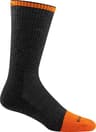
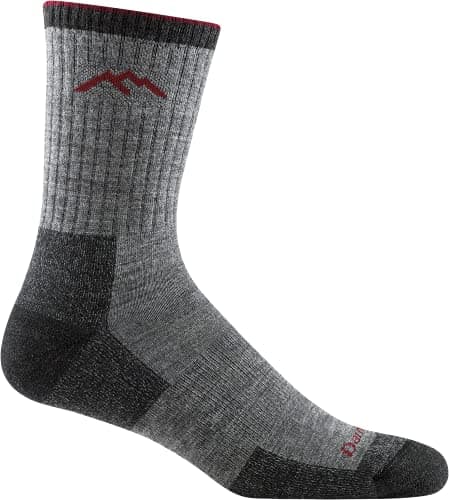
A proper boot sock reinforces exactly that area. Darn Tough calls it a full cushion toe box; Thorlo pads it heavily; Carhartt reinforces it in a synthetic blend. It is the single feature that distinguishes a boot sock from a thick walking sock.
The other three design features that matter
Cuff height. A boot sock needs to come above the boot shaft, or the shaft edge rubs bare skin. For a six-inch boot that means a crew; for an eight-inch, a taller boot height.
Elastic arch support. A band across the instep holds the sock in place so it does not creep down inside the boot and bunch under the arch - which is the single most common cause of work blisters.
Seamless toe. A bulky toe seam becomes a pressure point under a steel cap. Every sock on this page has a flat or seamless toe closure.
Wool or synthetic
Wool for long days, cold weather and anyone whose boots come off smelling of themselves. Merino absorbs moisture into the fiber and does not give odor bacteria a surface to colonize. It also keeps insulating when damp.
Synthetic for warm weather, for wet work where socks need to dry overnight, and for anyone buying in bulk. Carhartt’s Force socks are cheap enough to own ten pairs of, which has its own practical logic.
Note that Carhartt’s published limited warranty covers defects in materials and workmanship and explicitly excludes normal wear and tear - so a sock worn through is not a claim. That is normal for the category and it is the opposite of Darn Tough’s unconditional lifetime guarantee, which covers precisely that.
Fit, and the half-size problem
A full cushion sock takes up real volume. If you measured for boots in thin socks and then wear full cushion to work, the boots will be too tight and you will blame the boots.
Buy both together, or at minimum try boots on in the socks you intend to use. This is the most common fitting mistake in work footwear and it is entirely avoidable.
How many, and how to wash them
Four pairs minimum, so each gets a full day to dry and recover between wears. Wash inside out, no fabric softener - it coats the fibers and kills the moisture handling. Air dry or tumble on low.
And keep the Darn Tough claim form bookmarked. A guaranteed sock thrown in the bin is the most common way this category’s value gets wasted.