The one thing that decides this list
Every boot here was picked on a single question: when the sole wears through, is the boot finished? That is not a subjective judgment. It is decided by the construction method, which is fixed at the factory and usually published.
A Goodyear welt stitches a leather strip to the upper and insole, and the outsole stitches to that strip. Cut the stitches, pull the sole, stitch a new one on - the upper is never touched. A stitchdown boot achieves the same thing by folding the upper outward and stitching it to the midsole; Danner builds this way. Cemented boots glue the sole on. Direct-attach boots mold polyurethane straight onto the upper in a press. The last two make lighter, cheaper, often more comfortable boots - and they make the sole and the boot one object.
Why the Iron Ranger wins
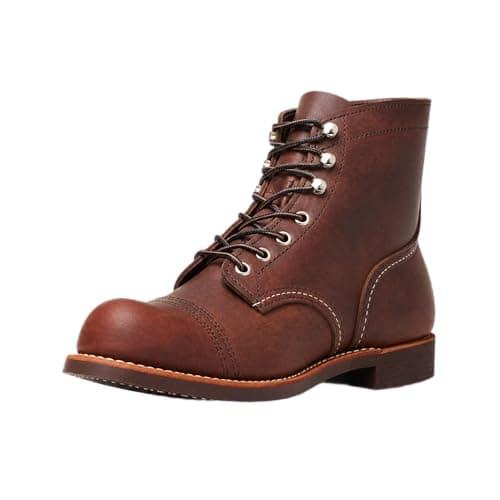
Red Wing's Iron Ranger is not the best-made boot in the world and it is not the most comfortable one on this page. It wins because it is the clearest case of the thing this site measures: a Goodyear welt, a thick Amber Harness upper, a factory in Minnesota, and a company that operates its own repair shop and resoles through its own stores with original parts. The sole is a three-year consumable bolted to a forty-year boot, and both halves of that sentence are documented.
The warranty is not the reason. Red Wing publishes twelve months against defects in workmanship and materials, original purchaser only, original receipt required, with failures from excessive or abusive wear excluded. That is an ordinary warranty. In this category, almost all of them are - which is exactly why you should buy on the welt and not on the promise.
Where Danner beats it
Danner publishes a Recrafting program: certified repair partners perform at minimum a standard resole and rebuild, replacing worn outsoles, reconditioning the leather and restoring the original fit and structure. That is a stronger commitment than a resole, because it addresses the parts a cobbler will not touch. The Mountain Light is heavier and more boot than most people need, and the Gore-Tex liner is the one component a rebuild cannot fully restore - membranes fail and cannot be replaced in situ.
The value bracket is better than it looks
Thorogood builds the American Heritage line in Wisconsin with a Goodyear storm welt, at well under the price of the Red Wings. The compromise is the wedge sole, which is genuinely excellent on flat concrete and genuinely poor on ladders, mud and loose ground. Carolina's Elm logger is the cheapest welted boot we are willing to recommend - thinner leather, but the same repairable architecture.
Thursday sits between them and is the boot we recommend most often to people buying their first welted pair. It is welted, it is comfortable in days rather than weeks, and it costs roughly half what a US-made boot does. The leather is thinner and will crease deeper. That is the trade, and it is a reasonable one.
What we left off, and why
Blundstone is the most-recommended boot on the internet and it is not on this list. The reason is its own support documentation: most Blundstones use an injected polyurethane sole and cannot be resoled successfully. Only the Heritage series, which uses a Goodyear welt, is designed to be. Blundstone deserves credit for saying so plainly where other brands imply otherwise - but a boot that cannot be resoled does not belong on a page about boots that last.
The same logic removed the direct-attach and cemented work boots that dominate the sub-150-dollar bracket. They are not bad boots. They are three-year boots, and this page is about the other kind. If a three-year boot is what you want, buy one deliberately and budget for the replacement.
Before you buy: the arithmetic
A 350-dollar welted boot resoled twice at 120 dollars costs about 590 dollars over fifteen years - roughly 39 dollars a year. A 120-dollar cemented boot replaced every three years costs 600 dollars over the same period. The welted boot wins, but narrowly, and only if you actually get it resoled. A boot you never take to a cobbler is just an expensive boot. That caveat is where most buy-it-for-life reasoning collapses, and it is worth facing before you spend the money rather than after.