What under $200 actually buys in a work boot
This is the most interesting price bracket in boots, and for a reason nobody advertises. Somewhere around $120 the market stops being uniformly disposable and starts containing a handful of boots built on genuinely repairable constructions. By about $250 almost everything is repairable again. In between - call it $130 to $200 - the two kinds of boot sit on the same shelf, at the same price, looking almost identical, and the difference between them is worth thousands of dollars over a working life.
The difference is how the sole is attached. A Goodyear welt stitches a strip of leather to the upper and the insole, and the outsole stitches to that strip. Any cobbler with a sole stitcher can cut those stitches, pull the worn sole off, and stitch a new one on without ever disturbing the upper. A stitchdown construction folds the upper outward and stitches it directly to the midsole, and is equally rebuildable. Both make a boot where the part that wears out - the sole, always the sole - is a replaceable consumable.
Cemented construction glues the sole on. Direct-attach molds polyurethane onto the upper in a press. Both produce a cheaper, lighter, often more immediately comfortable boot, and both fuse the sole and the boot into one object. When the tread goes, the leather goes with it, however good the leather was. That is not a scandal and it is not hidden - Timberland PRO literally puts the construction in the product name - but almost nobody buying a boot knows to look for it.
So the ranking below is built on the resole path first and comfort second, and three of these five boots are repairable while two are not. The page says which is which, in plain words, including for the two picks we still recommend.
How we judged these
1. Can the sole be replaced? This is the whole question. A welted boot with mediocre leather outlives a cemented boot with excellent leather, because the leather is almost never the thing that fails first.
2. What is the leather, and how thick? Full-grain means the outer layer of the hide with its grain intact - the densest, most abrasion-resistant part. Top-grain has had that surface sanded off and a finish sprayed on. In this bracket the leather is thinner than it is on a $350 boot even when it is genuinely full-grain, which means it creases deeper and sooner. That is the honest trade at this price.
3. Is there a published repair or warranty route? For these five boots the answer is almost uniformly no, and we say so on every entry rather than implying otherwise. Red Wing publishes 12 months against defects, original purchaser, receipt required, and runs its own repair shop; Danner publishes a Recrafting program through certified partners. Neither of those boots is under $200. What the boots here have instead is a construction that any independent cobbler can work on, which is worth more than a warranty you have to argue about.
4. Will you actually wear them? A boot that hurts gets left in the garage, and a boot in the garage has a service life of zero. This is why two cemented boots are on this page at all: there are jobs and feet for which a comfortable three-year boot is the correct purchase, and pretending otherwise would be dishonest.
Prices move constantly in this bracket, and two of these five sit within a dollar of the $200 line. Every price on this page is pulled live rather than typed in - check the number next to the boot, not the number in the heading.
Best overall under $200: full-grain leather on a stitched sole
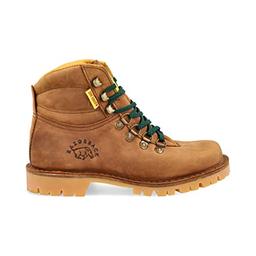
The Jim Green Razorback is the most boot you can buy for under $200 on this site’s terms, and the reason is thickness. South African-made, full-grain, built on a stitched construction a cobbler can rebuild - and the hide is noticeably heavier than anything else in this bracket. On a boot where thin leather is the usual compromise, that is the detail that matters most ten years out.
It is also genuinely water-resistant without a membrane. That is a durability point rather than a comfort one: a waterproof membrane is a consumable laminate that eventually delaminates and cannot be replaced, so a boot that keeps water out through leather and oil alone has one fewer thing to fail. Treat it with a wax or oil dressing twice a year and the water resistance is renewable, which a membrane never is.
The honest cons: Jim Green sizes to its own last and the return trip is long if you get it wrong, so read the brand’s own sizing guidance rather than guessing from your sneaker size. It is heavier than it looks. And like everything here, no published warranty terms could be found - the stitched sole is the promise, not a document.
Best budget pick: the cheapest welt on the page
The Carolina Elm is the entry point to welted construction, and it does the one thing that matters at a price where almost everything else is glued. It is unlined, which sounds like a cost cut and is actually a durability feature: an unlined boot dries from the inside out rather than trapping moisture against the leather, and trapped moisture is what rots a lining and then the stitching. It is also EH rated for electrical hazard, which matters if you work anywhere near live conductors.
What you give up is leather thickness - this is the thinnest hide in this list - and warmth. Unlined means cold in winter, full stop. If you work outdoors in January, this is the wrong boot and the insulated pick further down is the right one, with its own very different compromise.
The arithmetic still favors it heavily. A welted boot at the bottom of the market, resoled twice at a cobbler, will see out a decade. Two or three cemented boots at the same unit price will not, and will cost more in total.
Best to wear off the job: welted, and it does not look like a work boot
The Thursday Captain is a Goodyear welted boot at a price where nearly everything is cemented, with a last sleek enough to wear with trousers. That matters more than it sounds on a buy-it-for-life site: a boot that covers both the job and everything after it is one pair of boots instead of two, which is the cheapest durability there is.
It is also much easier to live with on day one than a heritage work boot. There is far less break-in than a Red Wing or a Thorogood, and no month of stiff-toed misery.
The compromises are real and they are in the leather and the sole. The hide is thinner than the US-made boots at twice the price, so it creases sooner and deeper. And on some makes the rubber outsole is cemented to the welt, which complicates a first resole - your cobbler can still do it, but ask before you buy rather than after the tread goes. No published warranty terms could be found, and Thursday does not run its own repair shop, so the cobbler is the whole plan.
Best comfort, and the honest reason it will not last
The KEEN Utility Detroit XT is one of the most comfortable safety boots you can buy out of the box. Genuinely waterproof, a wide toe box that fits feet other brands do not, and no break-in to speak of. For anyone who has given up on work boots because every pair hurt, this is the pair that does not.
It is also cemented. The sole is glued to the upper rather than stitched to a welt, so there is no practical resole path, and the midsole compresses long before the upper is anywhere near worn out. Expect two to four years of regular wear and then a new pair.
We are keeping it on the page because that is a legitimate purchase and a dishonest omission would be worse than an honest caveat. If a comfortable boot is the difference between wearing safety footwear and not wearing it, buy the comfortable boot. Just price it as a consumable rather than an heirloom, and do not let the leather quality fool you into thinking you have bought the other kind of boot.
Best insulated: and what “direct attach” actually means
The Timberland PRO Direct Attach is the cold-weather answer here, with 400g of insulation and a membrane that genuinely keeps water out. For outdoor winter work at this price there is not much competition.
The name is also a disclosure, and it is worth understanding. Direct-attach construction injects and molds the polyurethane outsole straight onto the upper under pressure. It makes an unusually watertight joint cheaply - that is why it exists - and it makes the sole and the boot permanently one object. There is no resole. There is no repair. When the tread goes, the boot is finished.
On top of that, insulation packs down. Two or three hard winters and the 400g that kept your feet warm is noticeably less effective, with nothing to be done about it. So this is a two-to-four-season boot bought deliberately: cheap, warm, waterproof, disposable. If that is the job, it is the right tool. If you want to keep the boot, buy the Jim Green and wax it.
What we considered and did not feature
Blundstone 585. Qualifies on price and is left off on the merits. Blundstone’s own support pages state plainly that most of its boots cannot be resoled because the soles are injection-molded, and only the Heritage series uses a welt - which is more honesty than most heritage-branded competitors manage, and which makes the 550 and 585 good three-to-five year boots rather than buy-it-for-life ones, whatever the internet says. Two non-resoleable boots on this page is already the limit of what is useful; the Chelsea boot is a slip-on for everything except work, and the two above cover comfort and cold better for the same money.
Thorogood American Heritage. The cheapest genuinely resoleable American-made work boot we cover, union-made in Wisconsin on a Goodyear storm welt - and currently well over $200. If your budget stretches, it is the boot to stretch for; the wedge sole is the only real compromise and it is a poor choice on ladders and loose ground. We cover it against the obvious alternative in Thorogood versus Red Wing.
Anything with a hidden cement line. A number of boots in this bracket are sold with welt-looking stitching around the midsole that is decorative, with a cemented sole underneath. The tell is that the stitch line does not pass through a visible leather welt strip, and the maker never uses the word Goodyear. If a listing will not name the construction, assume cemented and price accordingly.
The arithmetic, which is the whole argument
Take a $150 welted boot. A resole at an independent cobbler costs a fraction of the boot, and you will want one roughly every two to four years of daily wear. Over twelve years that is one boot and three or four resoles. Now take a $150 cemented boot replaced every two and a half years: that is five boots over the same twelve years. The welted boot is cheaper in absolute dollars, and it is the same boot the whole time - broken in, shaped to your foot, with leather that has got better rather than worse.
This is why construction beats brand, leather grade and price in that order on this site. It is also why the two non-resoleable boots on this page are ranked below three cheaper ones that are. If you want the longer version of the argument, the resoleable boots roundup is built entirely around it, and what a Goodyear welt is explains how to spot one in a photograph.
Four habits that decide the outcome
Rotate pairs. Leather needs 24 hours to dry out properly. A boot worn every single day stays damp inside, and damp leather stretches, cracks and rots its own stitching. Two pairs alternated last more than twice as long as one pair worn daily - this is the single highest-return habit in the category.
Condition twice a year, not monthly. Over-conditioning is a real failure mode: too much oil softens the leather past the point where it holds its shape, and a slumped upper creases in new places. Clean, let dry, condition thinly, twice a year. Our leather conditioner comparison covers which product for which finish.
Resole before the welt wears. This is the mistake that turns a repairable boot into a bin boot. Once the tread wears through to the midsole and then into the welt stitching, there is nothing left for a cobbler to stitch to. Watch the heel edge and the ball of the foot, and book the resole while there is still sole left.
Dry them slowly. Never on a radiator, never with a heat gun. Heat drives the oils out of leather and shrinks the fibers, and the result is the cracking across the vamp that people blame on cheap leather. Newspaper, room temperature, 48 hours.
The short answer
If you want one pair of work boots under $200 and you intend to keep them, buy the Jim Green Razorback: the thickest full-grain hide in the bracket, a sole a cobbler can replace, and water resistance you can renew with a tin of wax. If the budget is tighter, the Carolina Elm gets you a real welt for less and gives up warmth and leather thickness to do it.
If the boots also have to look right off the job, the Thursday Captain is welted and does not read as a work boot. And if you need comfort above everything, or insulation above everything, the KEEN and the Timberland are the right tools - just buy them knowing you have bought a three-year boot, which is a perfectly rational thing to do once you know you have done it.