If you want a watch you will still own in forty years, buy mechanical; if you want a watch that is accurate and asks nothing of you, buy quartz. A mechanical movement is a serviceable machine - cleaned, re-oiled and rebuilt as often as needed, limited only by parts availability. A quartz movement is usually a sealed module that is swapped rather than repaired, and when that module goes out of production the watch has no path forward. That is the entire comparison, and everything below is detail.
How each one works, briefly
A mechanical watch stores energy in a wound mainspring and releases it through a geared train regulated by a balance wheel oscillating a few times a second. An automatic is a mechanical watch with a rotor that winds the mainspring from the motion of your wrist. Both are the same machine; the automatic just winds itself.
A quartz watch passes a current through a quartz crystal cut to vibrate at 32,768 Hz, counts those vibrations and drives the hands with a tiny stepper motor. The frequency difference - thousands of cycles a second against a handful - is why quartz is orders of magnitude more accurate, and it is physics rather than craftsmanship.
Where quartz simply wins
- Accuracy. Seconds per month against seconds per day. No mechanical watch at any price keeps up with a cheap quartz movement.
- Shock resistance. Fewer moving parts under load. A Casio G-Shock survives impacts that would need a balance staff replaced in a mechanical watch.
- Maintenance. A battery every few years, or nothing at all on a light-powered movement, against a full service on a mechanical.
- Cost of ownership. One quartz battery change costs a fraction of one mechanical service, and the intervals are similar.
- Sitting in a drawer. A quartz watch is right when you pick it up. An automatic is stopped and needs setting.
Where mechanical wins, and it is the one that matters here
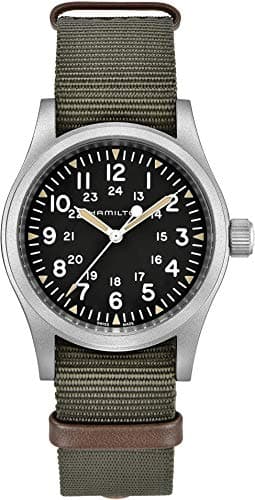
Parts and repairability. A mechanical movement is an assembly of discrete components, every one of which can in principle be made again. The Hamilton Khaki Field Mechanical is the clearest example on this site: hand-wound, no rotor, no date, nothing in it a watchmaker cannot fix with parts that will still exist in 2070.
Most quartz watches, by contrast, are serviced by module replacement. That is fast and cheap while the module is in production and terminal when it is not. The exception is the high-grade quartz and light-powered movements with real service networks - Citizen service centres replace the Eco-Drive cell and gaskets, which keeps a Promaster going far longer than a disposable quartz watch would.
There is also the honest contradiction at the bottom of the mechanical market, which we have written about on the mechanical watches under $500 page: on a very cheap automatic, a full service costs more than the watch. The movement is serviceable in theory and uneconomic in practice.
The four watches, as four positions
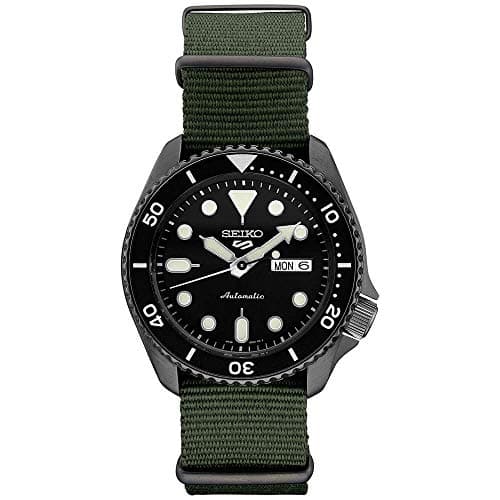
Seiko 5 Sports - mechanical, mass-produced, serviceable
The 4R36 hacks and hand-winds and is in millions of watches, so parts and knowledge are everywhere. Three-year worldwide warranty. This is the right mechanical watch to start with precisely because its ubiquity is the durability feature.
Hamilton Khaki Field Mechanical - mechanical, maximally serviceable
Hand-wound Swiss simplicity with Swatch Group parts support, warranted for twenty-four months. The absence of a rotor and a date complication is the point: fewer parts, fewer failures, simpler service.
Casio DW5600 - quartz, and arguably the most durable object here
Resin case, cheap module, 200m rating, battery life in years. Straps, bezels and batteries are all cheaply available and user-replaceable, which is why thirty-year-old DW5600s are still in daily use. Casio publishes no warranty terms we could verify for it - and it barely matters, because the watch costs less than most services.
Citizen Promaster Eco-Drive - quartz without the battery problem
Light-powered, so no winding and no battery changes, in Super Titanium. The capacitor is a wear part with a finite life and is replaceable at a service centre. Citizen offers an additional year of warranty coverage on registration, with base terms varying by market.
The buy-it-for-life reading
On this site the test is not which technology is better, it is which object you can still own in thirty years. By that test:
- A simple mechanical watch from a maker with parts support is the most genuinely permanent choice, and it will cost you a service bill periodically.
- A cheap, ubiquitous quartz watch with user-replaceable parts - the G-Shock case - is permanent in a different way: not repaired so much as endlessly re-batteried and re-strapped for almost nothing.
- A mid-priced fashion quartz watch with a proprietary module is the one genuinely disposable option, and it is the most commonly bought.
If your automatic keeps stopping rather than keeping time, that is usually not a fault - our why does my automatic watch stop page covers the power reserve maths before you pay anyone for a service.
What a service actually is, and what it costs you in time
On a mechanical watch, a full service means stripping the movement, cleaning every component, replacing the gaskets and any worn parts, re-oiling, reassembling and regulating it. It is skilled work and it takes weeks rather than days, because the watch goes away.
That is the real cost people underestimate - not the bill, the absence. If a watch is your only watch, a service means a month without it, which is one reason the cheap-quartz strategy is more popular in practice than watch forums suggest. On a quartz watch the equivalent operation is a battery and a gasket set, done over a counter.
The interval is also widely over-stated. A modern automatic worn normally does not need a service on a calendar; it needs one when it starts losing time badly, when the power reserve collapses, or before you trust its water resistance again. Our watches that last a lifetime page covers which movements are economic to service and which are not - because at the bottom of the market, a service costs more than the watch, and that is the honest limit of the mechanical argument.