We are not going to print a service price we did not verify. What we can tell you is the interval - five to eight years, commonly published - what the work consists of, and the one calculation that decides whether your watch should be serviced at all. That calculation is simple: if a full service costs more than roughly a third of what the watch costs to replace, the watch is a consumable. If it costs much less, servicing it is the cheapest watch you will ever buy.
Why the interval exists at all
An automatic movement is a gear train turning in jewel bearings, lubricated with very small quantities of specialised oil. That oil is the consumable. Over years it thickens, it migrates away from where it was placed, and it eventually stops separating metal from metal.
Up to that point, a service restores the watch completely. Past it, the pivots and jewels have started to wear and you are replacing parts rather than cleaning them - which costs more and, on an inexpensive movement, quickly stops making sense. The interval is not a maintenance upsell; it is the window in which the cheap version of the work is still possible.
What a full service actually involves
Worth knowing in detail, because it explains the cost and separates a real service from a cosmetic one.
- The movement is removed from the case and stripped to individual components.
- Every part is cleaned ultrasonically, inspected under magnification, and anything out of tolerance is replaced - the mainspring usually as a matter of course.
- The movement is reassembled and re-lubricated with the correct oils at each point.
- Gaskets at the case back, crown and crystal are replaced, which is what restores the water rating.
- The watch is regulated for accuracy, then pressure-tested, then run for several days before it goes back.
A shop that does not strip the movement has not serviced the watch. Pricing varies hugely by brand, by movement complexity and by whether you use the manufacturer or an independent, which is exactly why no single number on a web page can be right for every case.
The arithmetic, applied to four watches
This is where the picks on this page come from, and the ranking is by service economics rather than by quality.
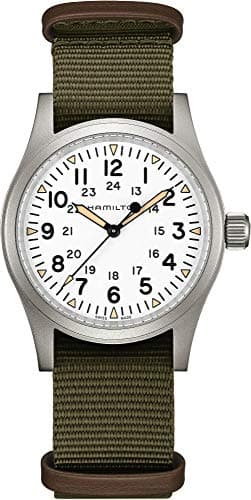
Hamilton Khaki Field Mechanical - the best candidate here. Hand-wound, so there is no automatic rotor to service; no date and no complications, so the work is straightforward; and Swatch Group parts support means a watchmaker can still get components decades out. Hamilton warrants the watch for twenty-four months from purchase, which is short, and irrelevant to the thirty-year question.
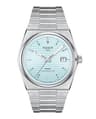
Tissot PRX Powermatic 80 - the same Swatch Group service network and parts access, two years of warranty (three on COSC-certified models), and a silicon hairspring that resists magnetism, which removes one of the common reasons a watch suddenly runs badly. The integrated bracelet is the long-term dependency: no strap swaps without proprietary parts.
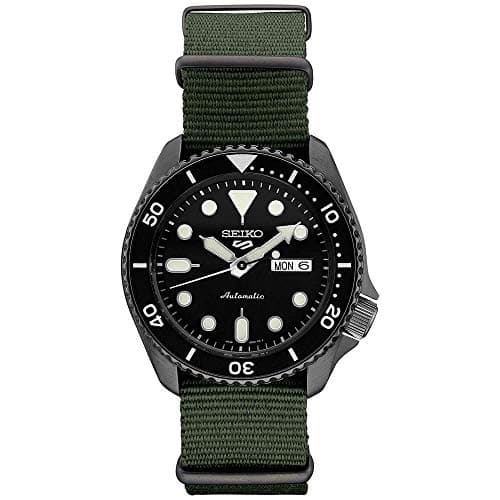
Seiko 5 Sports - the honest counter-example. A fine watch and a widely serviced 4R36 caliber with available parts, but as its own registry entry says, service economics are still marginal at this price. Treat it as a watch to wear and replace rather than one to maintain, and spend the service money on the next one. Seiko’s three-year warranty is the longest on this page.
Citizen Promaster Eco-Drive - the sidestep. Light-powered, so no battery changes and no winding, in Super Titanium that is harder than steel. The long-term question is the rechargeable cell: it is a wear part with a finite life, typically quoted in decades, and replacing it is a service-centre job. Lowest maintenance here by a distance, at the cost of there being no mechanical movement to keep alive.
Four things that are not a service
- A watch running fast or slow is often just magnetised, and demagnetising it takes a watchmaker a couple of minutes.
- A watch that stops when you take it off is usually behaving exactly as designed - see why does my automatic watch stop.
- A loose bracelet or a worn strap is a part swap, not a service.
- A scratched crystal is a crystal and gasket replacement, which can be done without touching the movement.
Ruling those out first is how people avoid paying for a full strip when they needed twenty minutes of attention.
The rule, stated plainly
Service a watch when the work costs a sensible fraction of replacing it, when parts for the movement are still supplied, and when the watch is something you intend to keep. That combination is true of the Hamilton and the Tissot, marginal on the Seiko 5, and not applicable to the Citizen in the same way.
If you are choosing a watch now rather than deciding about one you own, best mechanical watches under $500 ranks the field with service and warranty front and centre, and automatic vs quartz covers the more fundamental version of this decision.
How to get a sensible quote
Service pricing is quoted, not listed, so the useful skill is asking for the right thing. Four questions get you a comparable number from any watchmaker.
- Is the movement being stripped, or just cleaned in the case? Only the first is a service.
- Is the mainspring included, or extra? It is a routine replacement on most full services and a common source of a surprise on the invoice.
- Are gaskets and a pressure test included? Without them the water rating is not restored, whatever the paperwork says.
- What warranty do you give on the work? A year or two is normal from both brand centres and good independents. No warranty on the labour is a reason to go elsewhere.
Ask those four and two quotes become directly comparable. Ask none of them and you are comparing a strip-and-rebuild against a wipe-down.