Dry the pan on the burner until it is too hot to touch, wipe on a film of oil so thin the pan looks dry, let it cool completely, and stack it with paper between each pan. That routine takes two minutes and it is the difference between a skillet you hand on and a skillet you rescue every spring. Almost no cast iron rusts during cooking; it rusts in the cupboard, and it rusts for one of three avoidable reasons.
Why storage is where cast iron dies
Seasoning is a layer of polymerised oil, and it is not a perfect hermetic seal. There are always microscopic gaps, plus whatever got scratched off this week. Rust needs iron, oxygen and water, and a cupboard supplies the first two permanently - so the only variable you control is the third.
That is the entire theory, and it explains all three classic mistakes. A towel-dried pan keeps an invisible water film. A pan put away warm condenses its own moisture back onto itself in a closed space. A lidded dutch oven becomes a sealed humid box. In all three cases the water is sitting on iron for hours or weeks, which is all rust ever needs.
The products that matter, and the ones that do not
Storage maintenance needs an oil or a compound, and a way to take carbon off before you store. Four things cover it.
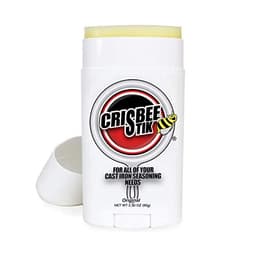
Crisbee Stik is a solid puck of oil and beeswax you rub onto a warm pan. The beeswax is why it works better than plain oil for maintenance - it stays put long enough to polymerise rather than running to the lowest point. Lodge Seasoning Spray is canola oil in an aerosol, and its only genuine advantage over a bottle and a rag is that you will actually do it, because it takes ten seconds. That is not a trivial advantage for a step whose whole value is consistency.
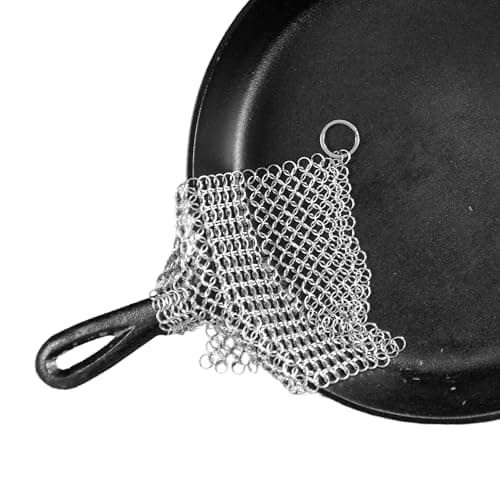
The Ringer and the Lodge Chainmail both shift stuck carbon that a brush cannot, without stripping the seasoning underneath the way steel wool does. The Ringer is bare 316L stainless chainmail and slightly more aggressive; the Lodge version has a silicone core that makes it considerably more comfortable to hold. Either one is a lifetime purchase - there is no realistic wear-out mode for stainless chainmail.
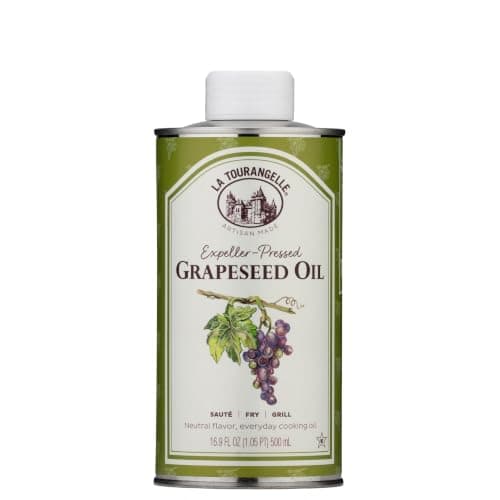
What you do not need: a dishwasher-safe claim, a cast iron “conditioner” sold at four times the price of oil, or a pan sleeve. A folded piece of kitchen paper does the job of the sleeve for nothing. Our best oil for cast iron page compares smoke points properly if you want to use a bottle rather than a compound.
Where to store it, ranked
- Hanging, or on the hob. Best of all - air on every surface, and a pan you can see is a pan you use. The only cost is dust, and dust does not rust iron.
- In the oven. Dry, dark, convenient. Remember it is in there, and never store a seasoned pan in an oven you intend to self-clean.
- A dry cupboard, stacked with a barrier. Fine. Use paper or felt between pans, nest by size, and do not put the stack directly against an outside wall that gets cold.
- Under the sink. The one cupboard to avoid. It is the most humid place in the kitchen and it is where every leak happens.
- A garage, shed or basement. For long-term storage only, with a heavier coat of a wax-based compound and the lid off. This is the one case where you want the oil film to be visible.
Stacking without wrecking the surface
Metal rims dragging across a cooking surface is how most seasoning damage actually happens - far more than cooking ever does. Nest pans largest to smallest so the weight sits on the rims, and put a sheet of kitchen paper between each one. The paper is doing two jobs: stopping scratches, and absorbing any humidity that reaches the stack.
Enameled pots have the opposite problem. Enamel chips on impact, and stacked enamel pots chip each other at the rim where the coating is thinnest. Keep them separated or store them nested with a cloth, and never stack anything heavy on an enamel lid.
The twice-a-year check
Pans that get used weekly look after themselves. The ones that rust are the spares at the back of the cupboard. Twice a year, pull everything out, look for dull grey or orange patches, and re-oil anything that looks dry. It takes ten minutes for a whole cupboard.
If you find rust, nothing is lost - how to clean cast iron covers taking it off and how to season cast iron covers putting the surface back. That recoverability is the reason this material is on a buy-it-for-life site at all.
Storing it for months rather than weeks
Long-term storage - moving house, a holiday home, a pan you inherited and are not using yet - is the one case where the rules change. Over weeks and months the thin maintenance film is not enough, because it slowly oxidises and because the pan is sitting somewhere with less climate control than a kitchen.
- Use a wax-based compound, applied visibly. A beeswax-and-oil compound like the Crisbee Stik stays put where a thin oil film migrates. This is the only situation where you want to see the coating.
- Wrap it, do not seal it. Paper or cloth, never a plastic bag or cling film. Plastic traps any moisture that was already there and holds it against the iron for the whole storage period.
- Lids off, always. A lidded pot in a garage for a winter is the single most reliable way to rust a dutch oven.
Unpacking is the reverse: wash the compound off with hot water, dry on the heat, and re-season lightly before the first cook.