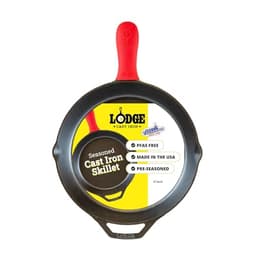
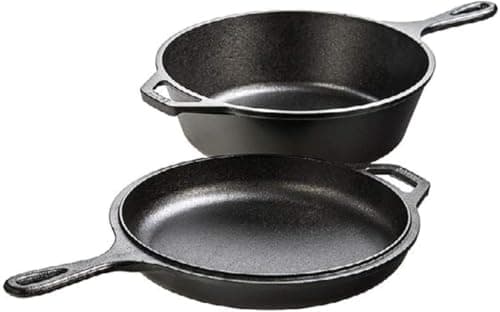
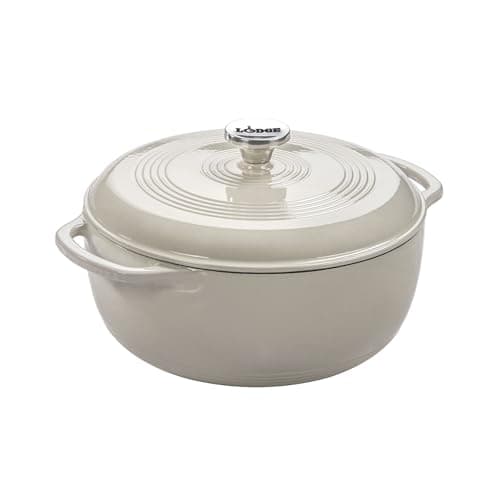
Buy bare cast iron first, and add enamel only when acid is the problem. Bare iron has a surface you renew yourself, which is why it cannot wear out; enamel has a surface that chips once and is then permanently compromised. Enamel earns its place for long tomato braises, wine reductions and anything you want to cook and then store in the same pot - and for those jobs the Lodge Essential enameled dutch oven does what a Le Creuset does at roughly a quarter of the price.
The same metal, two completely different surfaces
Underneath, these are the same thing: a cast iron body with huge thermal mass. Everything that differs is the half-millimetre on top.
Bare iron is finished with polymerised oil - seasoning - which you build, damage and rebuild indefinitely. That makes the cooking surface a user-serviceable part, which is an unusual and valuable property. Rust is reversible. A pan left in a shed for a decade comes back with steel wool, oil and an oven cycle.
Enamel is glass fused to the iron at high temperature. It is non-reactive, so acid cannot touch it, and it needs no seasoning at all. It is also brittle: it chips on impact, it crazes under thermal shock, and once it is through to the metal the pot is compromised in a way nobody can fix. There is no re-enamelling service for a domestic dutch oven.
Where each one wins outright
- Acidic cooking - enamel, no contest. A three-hour tomato braise strips seasoning off bare iron and picks up a metallic edge. In enamel it is a non-event.
- High-heat searing and the broiler - bare iron. No surface to craze, no temperature ceiling worth worrying about, and you can take it to a campfire.
- Storing food in the pot - enamel. Non-reactive and easy to wash means last night’s stew can live in it. Bare iron should not be a storage container.
- Bread - either, with a shape preference. For sourdough the shallow lid of a bare-iron combo cooker is genuinely safer to load than lowering dough into a deep enamel well. Our dutch oven sizing guide for sourdough covers that properly.
- Being indestructible - bare iron. The whole point of this website.
The warranties, in the brands’ own words
This is where the two camps separate most sharply, and where most comparisons of these materials simply assert “lifetime warranty” and move on.
Lodge, bare iron - the Made Right limited lifetime warranty covers normal household use and excludes commercial use, accidents, drops, mishandling, misuse, neglect and overheating. In other words it excludes everything that kills cast iron, which is fine, because you are the repair path.
Lodge, enameled - the same Made Right warranty, and here it does real work: Lodge’s terms explicitly cover enameled cast iron that chips, cracks or is otherwise damaged during normal cooking. That is a materially stronger position than the French brands take on the failure mode that actually happens.
Le Creuset - limited lifetime to the original owner, covering defects in material and workmanship only, non-transferable. Where Le Creuset judges damage to be user error such as thermal shock or dropping, it may offer 75% off the current retail price of a similar item instead of a replacement. Light enamel also stains permanently, and staining is not covered.
Staub - lifetime against defects, published by parent company Zwilling, with a matte black interior enamel that resists staining and scratching far better than light enamel. The trade is that you cannot see fond developing against black.
Cost of ownership, honestly
A Lodge 12-inch skillet and a Lodge combo cooker together cost less than one Le Creuset knob’s worth of brand premium, and both carry the same warranty category as the French pots. The Lodge Essential enameled dutch oven sits in the middle: a quarter of the French price, six quarts instead of the usual five and a half, a less even enamel finish, and essentially no resale value.
Resale is the one place the premium brands claw money back - a used Le Creuset holds its value in a way no Lodge does, which genuinely lowers the real cost of ownership if you ever sell it. Our Lodge vs Le Creuset page runs that arithmetic properly.
The two-pot answer
Most kitchens are finished with a bare cast iron skillet and one enameled pot, and in that order. The skillet does the searing, the bread, the breakfast and the hob-to-oven work. The enameled pot does the braises, the acidic sauces and the things that want to sit in the fridge overnight.
Buy the skillet now - it is the cheapest permanent object in your kitchen and how to clean cast iron is the entire maintenance story. Buy the enamel when a recipe tells you to, and read best enameled dutch oven before you pay French prices for it.
Three habits that decide which one survives
The failure modes are different enough that the care is different too, and in both cases the whole maintenance burden is three habits.
- Bare iron: dry it on the heat. Not on a towel. Ninety seconds on a burner until the water has flashed off, then a film of oil wiped back until the pan looks dry. Almost every rusted pan was put away damp - how to store cast iron covers the rest.
- Enamel: never heat it empty on a high burner. Empty and hot is the condition most likely to craze enamel, and crazing is the start of the only failure these pots have.
- Both: no thermal shock. Do not put a screaming hot pan into cold water. Bare iron can crack; enamel will craze. It is the one mistake that kills either material in a single moment.