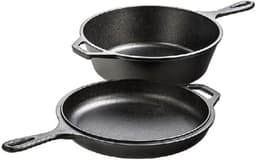
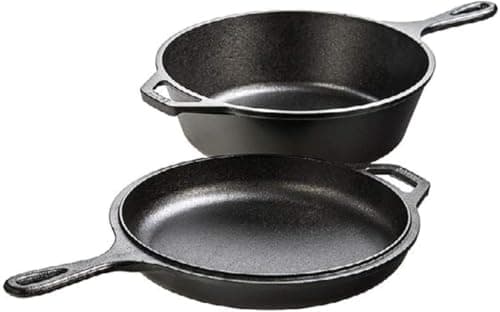
For a standard sourdough loaf, buy 5 quarts - and if you are buying specifically for bread, buy a combo cooker instead of a deep pot. Five quarts fits the 900g-to-1kg of dough that essentially every home sourdough recipe makes, with enough headroom for oven spring and little enough air that the steam stays where it is useful. The combo cooker wins because you bake on a shallow skillet with the pot inverted over it, which means you are laying dough onto a flat hot surface instead of lowering it blind into a 250C well.
Why the number matters less than people think
A dutch oven does two things for bread. It is a large mass of hot metal, which gives the base of the loaf an aggressive initial rise, and it is a sealed box, which traps the water evaporating out of the dough so the crust stays pliable for the first fifteen minutes and the loaf can expand before it sets.
Volume affects the second job only, and in one direction: too much empty space around the loaf means the dough’s own moisture has to humidify a larger volume, so the effective steam density drops. That is why a single loaf in a 9-quart pot bakes with a duller, thicker crust than the same loaf in a 5-quart. Under-sizing is the more obvious failure - dough touching the wall scorches and the loaf comes out with a flat side.
Sizing, by dough weight
- Up to 1kg of dough (the standard loaf) - 4 to 5 quarts, or a 3.2 quart combo cooker. This covers the overwhelming majority of recipes.
- 1kg to 1.4kg - 5 to 6 quarts. The 5-quart Lodge Double Dutch Oven is the sweet spot here and still gives you a skillet lid.
- Two small loaves at once - do not. Bake sequentially; the pot holds enough heat and the second loaf benefits from a fully reheated vessel.
- Batards rather than rounds - an oval 5 to 6 quart pot, or a combo cooker where the shallow base lets you place a long loaf without folding it.
The lid is the decision nobody writes about
Lowering a slack, proofed 900g boule into a deep preheated pot is the single most failure-prone moment in home sourdough. You cannot see the base, your forearms are inside a 250C vessel, and if the dough lands off-centre it stays off-centre.
A combo cooker inverts the problem. You turn the loaf out onto the shallow skillet, score it on an open flat surface in good light, and then put the deep pot over the top as a lid. Nothing is lowered into anything. That is why the Lodge Combo Cooker leads this page despite being the cheapest and smallest pot on it, and why the Lodge Double Dutch Oven - the same idea at 5 quarts - is the one to buy if your loaves are bigger.
Bare iron or enamel for bread
Both work. The difference shows up over years rather than loaves.
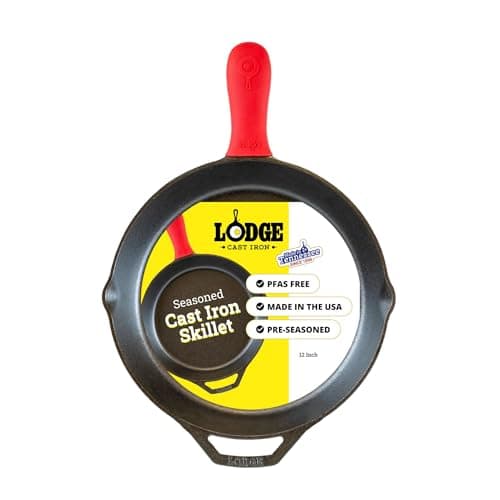
Bread baking means repeatedly preheating an empty vessel to 230-250C, and that is the single hardest thing you can ask of an enamel surface - empty, high, and thermally shocked when cool dough hits it. Bare iron has no equivalent vulnerability: there is nothing on the surface but seasoning, and seasoning is renewable. If bread is the main reason you are buying, bare iron is the longer-term answer, and it is also a quarter of the price.
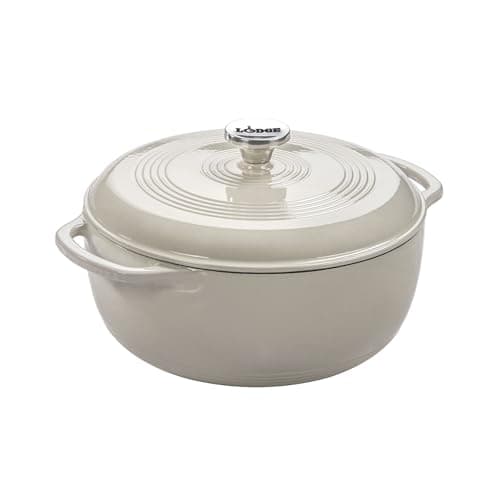
Enamel earns its place if the same pot has to braise. Le Creuset publishes a limited lifetime warranty on defects in material and workmanship to the original owner - and, read carefully, where it judges damage to be user error such as thermal shock or dropping, the remedy may be 75% off a similar item rather than a replacement. Staub carries a lifetime warranty against defects published by Zwilling, with matte black interior enamel that resists staining far better, at the cost of making fond much harder to see. Our cast iron vs enameled cast iron page goes through the trade in full.
Technique that the pot cannot fix
Three things undo a correctly sized pot, and all three are free to fix.
- Not preheating long enough. Forty-five minutes at baking temperature, with the pot in the oven from cold. The oven thermostat tells you about the air, not about five pounds of iron.
- Leaving the lid on too long. Twenty minutes covered for spring, then uncovered for the rest so the crust can actually colour and set. A loaf baked covered throughout comes out pale and leathery.
- Adding ice cubes or water to the pot. Unnecessary, and on enamel it is a thermal-shock event. The dough carries all the water the system needs.
So what to buy
If bread is the job: the Lodge Combo Cooker for standard loaves, the Lodge Double Dutch Oven if you bake bigger. If one pot has to do bread and braising both: a 5.5 quart enameled pot, with best enameled dutch oven for the full field and best bare cast iron dutch oven for the unenameled alternatives.
What the pot does to the loaf, and what it does not
Worth being clear about the limits of the equipment, because sizing advice online tends to imply that the vessel is doing more than it is. A correctly sized, correctly preheated dutch oven gives you two things: a strong base rise and a crust that stays pliable long enough for the loaf to expand. That is all.
It will not fix under-fermented dough, it will not fix a slack dough that was never shaped with any tension, and it will not create an open crumb on its own. If your loaves are dense, the problem is upstream of the pot, and buying a bigger one will not move it. What the pot does reward is a well-proofed, well-shaped loaf - which is why a twenty-dollar bare-iron combo cooker produces bread indistinguishable from a two-hundred-dollar enamel pot, and why we cannot recommend spending the difference for bread alone.