The best dutch oven under $100 is the Lodge Cast Iron Combo Cooker, because it is the only pot in the bracket whose cooking surface you can rebuild yourself. Everything else in this price range is a choice between that and enamel, and enamel buys you a non-reactive surface at the cost of a coating that cannot be repaired. Both answers are defensible. The one thing that is not defensible is buying either without knowing which trade you made, which is what this page is for.
The one decision that matters under $100
Cast iron is cast iron. The metal in a ninety-dollar pot and the metal in a three-hundred dollar pot are the same material with the same thermal mass at the same weight, and neither has a realistic wear-out mode. A cast iron pot does not fatigue, corrode through under normal use, or lose its ability to hold heat. Dropped on concrete it can crack, and that is essentially the whole failure list for the iron itself.
So the question in this bracket is never about the iron. It is about the surface, and there are only two kinds.
Bare cast iron cooks on seasoning - polymerized oil bonded to the metal. Seasoning is a consumable that the owner renews. Strip it with a harsh detergent, scorch it, or let the pot rust in a damp cupboard, and the fix is steel wool, oil and an hour in the oven. There is no version of a bare iron pot that is beyond saving, which is why these pots turn up at estate sales a century old and go straight back into service.
Enameled cast iron cooks on a glass layer fused to the metal. That layer is non-reactive, so it handles tomato, wine and vinegar without stripping or tasting metallic, and it is pale, so you can read how dark your fond is getting. It is also permanent in the wrong direction: you cannot repair it. A chip on the rim is cosmetic. A chip inside the cooking well exposes bare iron under a glass edge that will keep flaking, and the pot is on borrowed time.
That is the trade, stated plainly. Renewable surface that reacts with acid, or inert surface that is one bad knock from being compromised. Price does not resolve it and neither does brand.
How these four were judged
Three criteria, in this order, which is the same order this site applies to everything.
1. Can the surface be renewed? Bare iron scores highest because the answer is yes, indefinitely, by the owner, with no parts and no service program. Enamel scores lower because the answer is no.
2. What does the published warranty actually say about chipping? Not whether it says “lifetime” - nearly all of them do - but whether the document names the failure mode that actually happens to these pots. Most do not.
3. What is the pot made of and where. Bare Lodge is cast in South Pittsburg, Tennessee, and says so. The enameled lines in this bracket do not publish a country of manufacture we could read, so this page prints “Not published” rather than guessing.
The combo cooker is the best object here, and it is not close
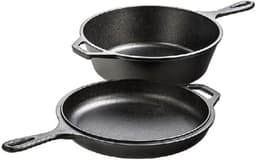
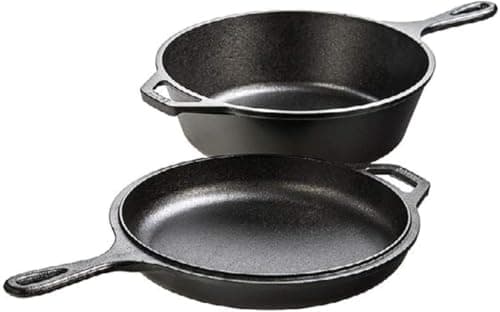
The Lodge Combo Cooker is a shallow skillet and a deeper pot that nest together, with the skillet acting as the lid. That makes it two pieces of cookware at one price, and it makes it the best bread vessel in this bracket by a clear margin: you turn a loaf out onto the shallow pan, score it, and drop the deep pot over the top as a cloche, so you never lower dough into a screaming-hot deep pot with your knuckles anywhere near the rim.
It is bare iron, so the surface is renewable forever, and Lodge's Made Right limited lifetime warranty covers it. It is cast in the USA. Against all that, the honest cons: it is small at a little over three quarts, so it is a two-person braiser rather than a family one; the lid-as-skillet design means no self-basting spikes and a looser seal than a dedicated braiser; and like all bare iron it will react with a long tomato braise, so acidic cooking wants the enamel instead.
If you want enamel, read the chip clause first
This is where the bracket gets genuinely interesting, because the two enameled pots here publish meaningfully different promises and the cheaper one is not the weaker one.
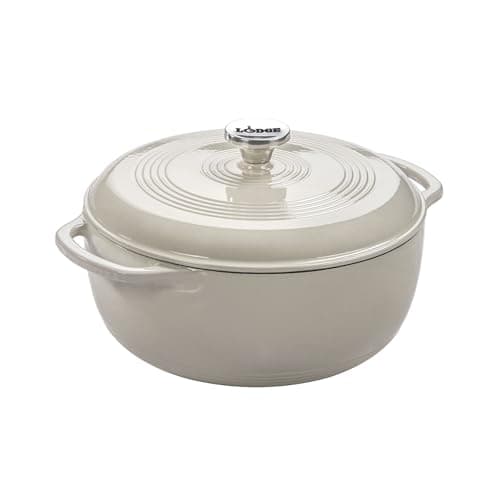
Lodge Essential Enamel is covered by the same Made Right limited lifetime warranty as the bare iron, and Lodge's document explicitly covers enameled cast iron that chips, cracks or is otherwise damaged during normal cooking. Read that again, because it is rare. The failure mode that ends enameled pots is named in the warranty. That is the strongest paper in this bracket and it is not a close call.
Tramontina Bestow warrants its cookware free from defects in material and workmanship for the lifetime of the original purchaser. That is a real lifetime warranty and a perfectly normal one - but “defects in material and workmanship” is not the same promise as “chips during normal cooking”, and the gap between those two phrases is where most enamel claims die. It is the better-looking pot of the two and the one with the wider usable interior; it is also the one whose warranty does not name the thing most likely to happen to it.
Honest cons on both: neither publishes a country of manufacture we could read, so both read “Not published” on that row. Both are heavy enough that a full pot is a two-handed lift out of a low oven. And both carry the structural disadvantage of every enameled pot - the surface is the one part you cannot fix.
The cheapest route in, and why it is still a serious pot
The outright cheapest pot on this page is the Tramontina, and if the budget is the binding constraint it is a perfectly good buy - a real enameled cast iron pot with a published lifetime warranty behind it. The caveat is the one from the section above: that warranty covers defects, not chips.
The Lodge Double Dutch Oven is the cheapest way into bare cast iron, which is a different and arguably better kind of value, because it buys a genuinely permanent object. Five quarts of bare cast iron with a lid that is itself a usable skillet, the Made Right warranty behind it, cast in Tennessee. For a first dutch oven it is close to unimprovable, because nothing about it can be worn out by a beginner and every mistake is reversible with steel wool.
What you give up: the same acid reactivity as all bare iron, a rougher as-cast interior than the enameled pots, and a lid that seals less tightly than a purpose-built braiser lid. None of those are durability problems. They are cooking-performance trades, and for most people the renewable surface is worth more than any of them.
What the expensive pots actually buy
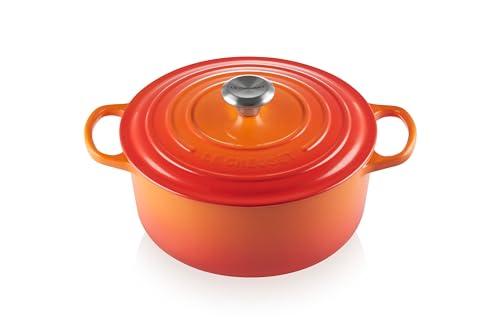
It is worth being precise about this, because the honest answer is more useful than either the marketing or the backlash. Spend three to four times as much and you get tighter enamel with fewer cosmetic flecks, a noticeably lighter casting for the same capacity, a wider pouring lip, better-balanced handles and a lid that seats more precisely. Le Creuset's own published warranty is a limited lifetime term covering defects, non-transferable, and where the company judges damage to be thermal shock or a drop its published remedy is a seventy-five-percent discount on a replacement rather than a replacement.
So the premium is real and it is almost entirely ergonomic and cosmetic. It is not a longer working life. A sub-$100 pot used for thirty years and a premium pot used for thirty years both end up as a pot that still works. Our is Le Creuset worth it page runs that arithmetic in full, and Lodge vs Le Creuset puts the two warranties side by side.
What actually ends a dutch oven
Worth listing, because almost none of it is the pot wearing out.
Thermal shock. The real killer of enameled pots and the one most people cause by accident. Taking a pot from a hot oven and running cold water into it, or setting a screaming-hot empty pot on a wet surface, puts the enamel and the iron under different rates of contraction. Enamel loses. Let it cool before it meets water, every time.
The lid. Dutch oven lids are heavy, awkward and get put down one-handed while the other hand holds a spoon. More enamel chips start on a lid rim meeting a counter than anywhere else. A folded towel beside the hob solves it permanently.
The knob. Check what it is made of before you buy, because it decides the pot’s oven ceiling. A phenolic knob is typically rated several hundred degrees lower than the pot itself, which matters the first time you want to finish bread at full heat. A stainless knob removes the limit, and on most pots it is a single screw to swap.
The dishwasher. Bare iron must never go in one - detergent strips seasoning and the drying cycle leaves it to rust. Enamel survives it but comes out duller each time, and the exposed rim on most pots is bare iron that will spot.
Nothing on that list is a manufacturing defect, which is exactly why reading the chip clause matters: the things that actually happen to these pots are usually the things a defects-only warranty does not cover.
Lids, seals and the self-basting claim
Premium enameled pots advertise spikes or rings molded into the underside of the lid, on the basis that condensation collects there and drips back onto the food rather than running down the walls. The effect is real and it is small. In a pot with a reasonably flat lid and a close fit, enough moisture returns to the food either way, because the lid is the coldest surface in the pot and that is where vapor condenses regardless of what is molded into it.
What actually matters is fit. A lid that sits flat and heavy loses less steam over a four-hour braise than a lid that rocks, and that shows up as a thicker sauce and less topping-up. This is one of the places where the premium pots earn their money honestly - the machining is better and the lid seats more precisely. It is also the kind of difference you stop noticing after a month of cooking.
Sizing, and the mistake that wastes the money
The most common sizing error is buying too big. A seven- or eight-quart pot full of braise is heavy enough that lifting it out of a low oven becomes a two-handed, both-mitts job, and the pot quietly stops getting used. A five-to-six-quart pot handles a whole chicken, a braise for four and a standard loaf, and it is light enough to use on a weeknight.
The second mistake is buying one pot for two jobs it cannot both do. Bread wants a tall, narrow vessel that traps steam around a round loaf. Braising wants a wide, shallow one that gives you surface area for browning. A combo cooker splits the difference better than most because the shallow half is a genuine skillet, which is why it leads this page despite being the smallest pot on it. Our what size dutch oven for sourdough page works the bread case through properly.
Care, which is the actual durability variable
For bare iron: cook in it often, dry it on a warm hob rather than a towel, and wipe a film of oil over the cooking surface while it is still warm. Rust is not damage, it is a maintenance signal. Our how to season cast iron guide covers the rebuild, and how to clean cast iron covers the part people get wrong daily.
For enamel: never let it go into a cold sink hot, never use metal tools on the cooking surface, and set the lid down on a cloth rather than a hard counter. Almost every chipped enamel pot was chipped by the lid, not the food.
The short version
If you want one pot and you want it to outlive you, buy bare iron and accept that acidic braises want a different vessel. If you braise with wine and tomato weekly, buy enamel and buy the one whose warranty names chipping. Both decisions are correct; only one of them is correct for your kitchen, and the price tag will not tell you which.
For the wider field at every price, our bare cast iron dutch ovens and enameled dutch oven roundups go past the $100 line, and cookware with a real lifetime warranty quotes every term in the kitchen hub with its exclusions.