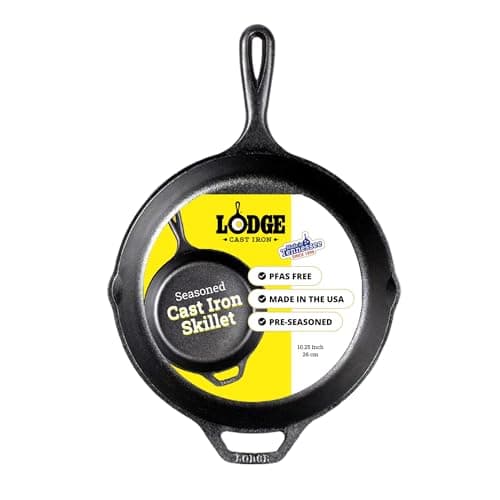
The cast iron griddle worth buying is the Lodge Reversible Grill/Griddle: flat on one side, ridged grill bars on the other, American-made, and covered by Lodge’s Made Right limited lifetime warranty. We are not going to pad this page with five near-identical slabs of iron to look thorough. The more useful question - and the one most people searching for a griddle are actually asking - is whether a griddle is the cast iron surface that suits your cooking at all. That is the rest of this guide.
Why there is really one answer
A cast iron griddle is a flat plate of cast iron. There is very little to engineer and almost nothing to differentiate: the variables are size, thickness, whether it is reversible, how the handles are shaped, and whether the brand publishes a warranty.
Lodge wins on the last one and ties on the rest. Its cast iron is covered by the Made Right limited lifetime warranty, it is made in South Pittsburg, Tennessee, and the reversible design means one piece of iron does two jobs. The seasoning is user-renewable and rust is reversible, so the only genuine way to destroy it is to crack it - which takes a concrete floor.
The premium cast iron brands do their interesting work on skillets, where thin walls, machined surfaces and lighter weight genuinely change the cooking. On a flat plate there is nothing for that engineering to do, which is why paying four times as much for a griddle buys you a smoother surface and nothing else that matters.
Which side of it you will actually use
The flat side is the reason to own it. It gives you a large, wall-free cooking surface, which matters for exactly three things: cooking several items at once without them steaming each other, pressing sandwiches, and anything you need to get a spatula under cleanly. Pancakes, bacon, eggs for four people, smash burgers, quesadillas, naan.
The ridged side is more conditional. Indoors, grill bars give you char marks and let fat drain away from the food, and they also produce far more smoke than most domestic extraction can handle. It is excellent on a gas hob with a window open and genuinely unpleasant in a small flat. Our cast iron cleaning guide covers the valleys between the bars, which is the one part of this piece that is annoying to clean.
Stove by stove
- Gas: ideal. A two-burner griddle sits across two flames and heats reasonably evenly. Preheat on medium-low for several minutes rather than blasting it.
- Electric coil: works well. The thermal mass of cast iron smooths out the slow response of a coil, which is the one place cast iron is actively better than a thin pan.
- Induction: fine for the pan, awkward for the geometry. A long griddle overhangs a single induction zone and only the part over the coil gets hot. Use a single-zone skillet instead unless you have a bridge zone.
- Glass or ceramic top: usable with care. Lift, never slide - cast iron bases are rough and glass scratches. Heat gradually, and accept that spanning two zones will be less even than on gas.
- Charcoal and gas grills: this is where the griddle is unarguable. It turns a grill into a flat-top, and it is the cheapest way to cook eggs or onions over live fire.
When a skillet is the better flat surface
If you are choosing your first or only piece of cast iron, buy a 12-inch skillet rather than a griddle. It has walls, which means it can hold fat for shallow frying, hold liquid for a pan sauce, and go into an oven with its contents. It will sear a steak as well as the griddle will, and it will do a dozen things the griddle cannot.
The griddle is a second piece of cast iron, bought because you cook breakfast for a household or because you want a flat-top on a barbecue. Bought as a first piece, it will frustrate you within a week. Our cast iron skillet roundup is the page to start on instead.
The third option is the combo cooker - a deep skillet with a shallow skillet as its lid, so you get two pans and a dutch oven in one object. It is the most versatile cast iron you can buy for the money and it is the best choice if cupboard space is the real constraint.
Seasoning a griddle, specifically
- Wash and dry it thoroughly. Dry it on a warm hob, not with a tea towel.
- Wipe a very thin layer of a high smoke point oil over every surface, then wipe it off again until it looks dry. Too much oil is the only way to get a sticky finish.
- On the ridged side, work the oil into the valleys with a cloth and then wipe the tops of the bars clean - oil pools between ridges and polymerises into a gummy layer if you leave it.
- Bake at a high oven temperature for an hour, let it cool in the oven, and repeat two or three times for a new piece.
- After that, cooking is the seasoning. Our oil guide covers which fats polymerise well and which go sticky.
The bottom line
Buy the Lodge reversible griddle if you want a large flat cast iron surface or a flat-top for your grill, and expect to own it for the rest of your life - cast iron has no consumable parts and no realistic end of life. Buy a 12-inch skillet instead if this is your first piece of cast iron, and buy the combo cooker if you want the most cooking per cupboard inch.