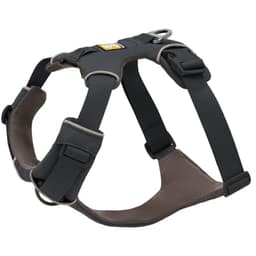
The most reliable, durable dog harness in this group is the Ruffwear Front Range: Tubelok webbing, aluminium V-ring and a published guarantee against defects in materials and craftsmanship. Kurgo publishes the stronger paperwork - a lifetime defects warranty plus a separate paid Replacement Service that covers wear and abuse - and 2 Hounds Design is the only maker here that will cover chewing at all, as a low-cost add-on bought with the harness. Reliability in this category is decided by the hardware and by what the maker commits to in writing, and both are printed in the table above.
What actually fails on a harness
Harnesses do not wear out evenly. They fail at a specific point, in a predictable order, and once you know the order the whole category sorts itself out.
Plastic buckles crack first. A side-release buckle is a molded plastic hinge under repeated load, left in the sun, dunked in salt water and stepped on. It survives for a year or two of ordinary use and it goes suddenly rather than gradually. On most harnesses it is not a replaceable part, so a cracked buckle is a dead harness.
Stitching at the load points goes second. Every harness concentrates the entire pull of the dog into two or three bar tacks. Where those tacks are clean, dense and backed with webbing, they outlast the dog. Where they are a single straight pass of thin thread, they unzip.
The webbing itself goes last, and it goes by abrasion rather than by breaking. Nylon that has been through two hundred walks, fifty swims and a winter of road salt feels furry. Furry webbing has lost real tensile strength, which is why a harness that looks tired usually is.
And then there is the failure mode that has nothing to do with construction: the dog eats it. That is excluded from essentially every warranty in this category, which is the single most useful fact on this page.
The criteria, in the order they matter
1. Metal where the load is. The ring the leash clips to, and any ring that carries the dog’s weight, should be metal - ideally cast or welded aluminum rather than a stamped steel loop. A stamped ring opens under load; a cast one bends. Everything else on a harness can be nylon.
2. A warranty we can read. Not a retailer’s summary and not a line on a marketplace listing - the brand’s own published document. Two of the five brands here clear that bar. Three do not, and they are marked “Not published” throughout, because on this site that means we looked and the brand does not say.
3. Enough adjustment to actually fit. A harness that fits badly rubs, and a harness that rubs comes off and stays off. Four adjustment points is the working minimum for a dog with any kind of chest; six is better if your dog is an unusual shape.
4. Padding where the dog carries the load - across the sternum and behind the elbows. Padding everywhere else is marketing and it holds water.
5. A design that survives washing. Anything you can throw in a bucket of warm water and scrub will get cleaned. Anything with foam sewn into a sealed channel will not dry, and it will smell for the rest of its life.
The paperwork, side by side
This is where the category separates, and it separates sharply.
Kurgo. A published lifetime warranty against manufacturer’s defects caused by poor craftsmanship or defective hardware or materials, when bought through an authorized dealer. Toys are excluded. Normal wear and tear is excluded. Damage from using the product in an unintended way is excluded by name. Claims are handled for the US and Canada only.
Then the part that is genuinely unusual: Kurgo publishes a separate paid Replacement Service alongside the warranty, under which everything except dog toys is covered regardless of the abuse, for a nominal fee. That is a better deal than most warranties, because it covers the thing warranties never cover - the dog.
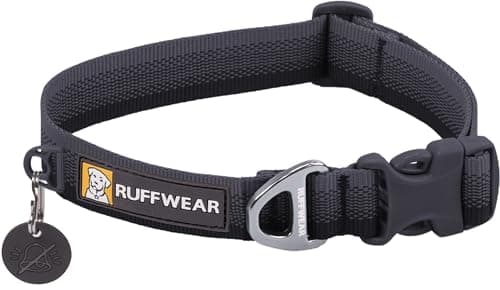
Ruffwear. A published guarantee against defects in materials and craftsmanship. Chewing, misuse and normal wear are excluded. It is a straightforward defects warranty, written plainly, and it is the same guarantee that sits behind the Ruffwear collar we already recommend.
2 Hounds Design. No general defects warranty we could find on the brand’s own site. What it does publish is a chewing warranty you purchase: the Freedom Harness Chewing Replacement Warranty, which costs around thirteen dollars, where one warranty is good for replacing one harness only. It does not cover the training leash, and dirty, outgrown or lost harnesses are excluded.
We like this more than it sounds. Chewing is the number one way harnesses die and every other brand simply excludes it. Selling the cover separately, cheaply, with the limits stated, is more honest than pretending the problem does not exist.
Blue-9 and rabbitgoo. No published warranty terms we could find. Judge both on hardware and construction alone, and price them accordingly.
Why the Ruffwear Front Range wins anyway
Kurgo has the better paperwork. The Front Range still wins, for one reason: the aluminum V-ring on the back.
That ring is the part every walk loads, every day, for the life of the harness. Cast aluminum does not open the way a stamped steel loop does, and it does not grind a groove into the clip of your leash the way a cheap chromed ring does. Pair it with four adjustment points and a padded chest and belly panel and you have a harness that fits a greyhound and a Staffordshire bull terrier equally well.
The honest cons: chewing is excluded, the webbing holds water and smell more than a biothane harness does, and the front attachment is a soft webbing loop rather than a metal ring - so on a dog that pulls hard against the front clip, that loop is the first thing to fray. If your dog is a committed puller, read our leash guide for dogs that pull alongside this, because the leash matters as much as the harness.
When to buy the Kurgo instead
Two cases. The first is if the warranty is the thing you are buying - the Tru-Fit is the only harness here with both a lifetime defects warranty and a paid replacement path for the damage that warranty excludes. The second is if the harness is going in the car, because the Tru-Fit includes a seatbelt tether and steel nesting buckles designed for that job.
The trade is fitting. Five adjustment points means the first fitting takes real patience, and the warranty is US and Canada only with an authorized-dealer requirement attached.
The no-pull question
The Freedom harness is the only one here whose no-pull behavior is mechanical rather than incidental. A martingale loop runs across the back; when the dog pulls, the loop tightens and gently draws the shoulders together, and it releases the moment the dog stops.
That is different from a front clip, which simply turns the dog sideways. Both work. The martingale is kinder on a dog that leans into pressure, and the velvet lining on the chest straps is there because that is exactly where a nylon harness rubs a bald patch behind the elbow.
A front clip is still the first thing to try, and four of the five harnesses here have one, so for most people the no-pull question is about which ring you clip to rather than which harness you own.
Fitting, which is where most of the complaints come from
Measure the girth right behind the front legs, at the widest point of the ribcage, with a soft tape pulled snug but not tight. Buy by that number, not by breed and not by weight - two 70-pound dogs can be two harness sizes apart.
Then set it so you can slide two flat fingers under any strap, the same test we use for collar tightness. Check the chest strap sits a couple of inches behind the elbow rather than in the armpit, which is the single most common cause of a harness rubbing a dog raw.
Re-check the fit after a month. Webbing seats in, buckles creep, and the harness you fitted perfectly in March is loose by May.
If your dog is head-shy, arthritic, or simply hates having things pulled over its face, the Blue-9 is the answer: the neck unbuckles, so the harness never has to go over the head at all. Six adjustment points also make it the one that fits dogs other harnesses will not - deep chests, narrow heads, barrel-shaped bulldogs.
On the budget pick
The rabbitgoo is in this roundup on purpose, and not as a token cheap option. A growing puppy will outgrow two harnesses before it needs a good one, and spending premium money on something that fits for four months is not a durability decision - it is just spending.
Buy it knowing what it is: two leash clips, four adjustment points, a padded mesh chest panel, no published warranty, plastic buckles that are the weak point and are not replaceable, and a mesh panel that takes a long time to dry. For a puppy, or a spare that lives in the car, that is a perfectly good set of trade-offs.
What we did not pick, and why
The Julius-K9 IDC Powerharness is a genuinely tough piece of kit and it was on our list. We left it off because we could not read a warranty for it on the brand’s own site - retailer listings in different markets quote one year and two years, which is exactly the kind of second-hand number this site exists not to repeat.
We also left off the entire category of padded tactical harnesses with molle webbing. They are heavy, they hold water, the padding never dries, and none of the ones we looked at publishes anything about hardware or warranty.
Why none of these are biothane
We are on record preferring biothane for leashes: it does not absorb water, it does not hold smell, and it wipes clean with a cloth. So why is every harness here nylon webbing?
Because a harness has to distribute load across a curved ribcage, and biothane is a stiff coated strap. It is excellent in a straight line and poor at wrapping a chest. The handful of biothane harnesses on the market are either unpadded straps that dig in, or they use so much hardware to get around the stiffness that they weigh more than the dog needs to carry.
Leather has the opposite problem. It conforms beautifully and it is genuinely repairable, but a leather harness needs the same care routine as a pair of boots and most people will not give a dog harness that. On price, expect to pay roughly supermarket money for the budget pick and about three times that for the top four - all of them sit well under what a mid-range leash and collar set costs together.
Making one last
Three habits, in order of how much difference they make.
Take it off indoors. This is the whole chewing problem solved for free. 2 Hounds Design says it plainly on its own warranty page: do not leave the harness on your dog when you are not actively using it, because a dog can chew through a strap in seconds.
Wash it, properly, four times a year. Warm water, ordinary soap, a brush, and then dry it somewhere airy. Salt and grit are abrasives; leaving them in the webbing is sandpapering your harness from the inside.
Check the stitching at the load points every few months. A bar tack that has started to open is a five-minute repair at any shoe repair or sail loft and a replaced harness if you miss it. Our gear repair guide covers the stitch itself.
Do those three and a good harness is a five-to-ten-year purchase. Skip them and the best harness on this page is a two-year one, and no warranty here will cover it.