Two fingers, flat, between the collar and the neck - and the collar sitting high on the neck, not slumped at the shoulders. That is the whole rule, and it works on every breed because it scales with the dog: two fingers on a terrier is a smaller gap than two fingers on a mastiff, which is exactly right. Any looser and the collar can pull over the ears when the dog backs up. Any tighter and it presses on the throat and wears a bald ring into the coat.
Measuring, properly, once
Put a soft tape around the middle of the neck, where the collar will actually sit - not at the base where it meets the shoulders, which is a bigger number and the reason a lot of collars arrive too loose. Hold two fingers under the tape while you measure, and write the result down.
Then buy the size whose adjustment range has your measurement near the middle. A collar sitting at the very end of its holes or its slider has no room for a thicker winter coat, for a dog that gains a little, or for a puppy that is still growing - and no room to let out if you got it slightly wrong.
What a collar that is too tight actually does
- It wears the coat away. A flat or bald ring around the neck is the most common sign, and it takes months to grow back.
- It presses on the trachea. Especially on flat-faced and small-throated breeds, and especially on a dog that pulls into the collar.
- It traps moisture and debris. A collar with no air under it stays damp after a swim or a wet walk, and damp against skin is where the sores start.
- It can embed, on a growing dog. This is the serious one, and it is why the weekly puppy check is not optional. A collar left on a fast-growing puppy for a few months without a check is a veterinary problem, not a fitting problem.
Too loose has one failure mode and it is sudden: the dog backs up, the collar comes over the ears, and the dog is loose. It usually happens next to a road.
Collar type by neck shape
The two-finger rule assumes a dog whose head is wider than its neck. For a dog where that is not true - sighthounds most obviously, but plenty of individuals in other breeds - a flat collar fitted correctly will still come off, and the answer is a different collar rather than a tighter one.
A martingale is a limited-slip design: it sits loose and tightens to a pre-set point, no further, when the dog pulls back. The Mighty Paw Martingale uses a stainless steel chain, which is the right material choice here - plated steel chains rust through at the links, and that failure is hidden inside the links until it goes. Set the stop so the collar cannot close smaller than the two-finger gap and it does the job without being a tightening device.
The Rogz Utility half-check is the same idea with a webbing loop and woven reflective material, and the detail that matters is that the reflective is woven through rather than printed on - printed reflectives wear off inside a season.
Material, and what it does to the fit over time
A webbing collar holds its length. A leather collar stretches a little in the first months and then stops, which means a leather collar fitted perfectly on day one is slightly loose by month three - re-check it rather than assuming. The DowgClub leather collar softens to the dog’s neck over a year and then stays that way, which webbing never does; it is also the wrong material for a dog that swims, because repeated soaking stretches leather and then cracks it. It can be re-punched, re-buckled and re-stitched by a saddler, which is more than any webbing collar offers.
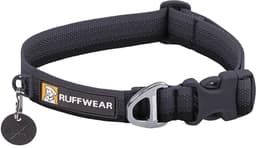
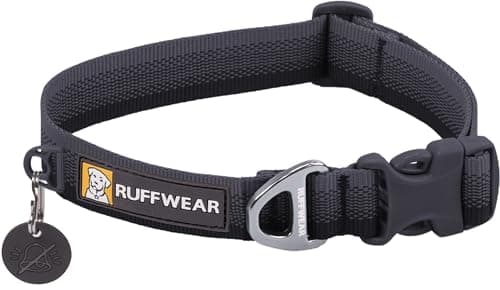
The Ruffwear Front Range is the everyday default, and the aluminium V-ring is the detail worth paying for: the ring is the part that wears, and aluminium outlasts the stamped steel rings on cheap collars. Ruffwear’s guarantee covers defects in materials and craftsmanship, with chewing, misuse and normal wear and tear explicitly excluded - which is honest, and which we quote in full alongside every other brand’s terms on dog gear warranties compared.
The check, on a schedule
Weekly for a puppy under six months. Monthly for an adult dog. And every time after a coat change, a weight change or a clip - a dog that has just been clipped short is wearing a collar that was fitted over twice as much hair.
Five seconds, two fingers, done. If you are still choosing the collar itself, best dog collars that last ranks the field on hardware and material rather than on pattern, and how long should a dog leash be covers the other half of the system.
Where the collar should sit, not just how tight
Fit has a second dimension that the two-finger rule does not capture: position. A collar belongs high on the neck, just below the ears and behind the jaw, rather than slumped down at the base of the neck where it meets the shoulders.
High on the neck, a correctly fitted collar cannot rotate much, cannot be pulled over the ears and sits on muscle rather than on the trachea. Slumped low, the same collar needs to be tighter to stay on, presses on the windpipe when the dog pulls, and chafes in the crease at the shoulder. If your dog’s collar keeps migrating downwards, it is a size too large whatever the tape says - check it against the two-finger gap measured where the collar should be, not where it has ended up.