The honest framing before anything else
This comparison is unusual on this site because the durability question has no answer. Cast iron does not wear out. There is no welt to resole, no cell to replace, no mechanism to seize. Both of these pans are a single piece of cast iron with a seasoning layer you renew yourself, and both will be in someone’s kitchen in eighty years.
So the useful question is not which lasts longer. It is what a price gap of several times buys you, and whether the thing it buys will change how often you reach for the pan.
The two pans
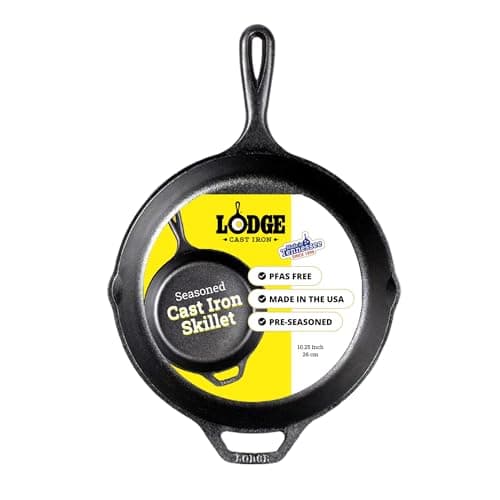
Lodge casts in Tennessee, in thick sand-cast iron with the pebbled texture the mold leaves behind, pre-seasoned at the factory. It is the default American skillet and has been for a century.
Field Company casts thinner and then machines the cooking surface flat and smooth, the way American pans were finished before the war. It is made in the USA, it is lighter than a comparable Lodge, and it costs several times as much.
Those are the only two differences that matter: surface finish and weight. Everything else said about this matchup downstream of those two things is either a consequence of them or marketing.
Surface finish: a real difference that shrinks
A machined surface is genuinely better from the first cook. Seasoning builds on a flat plane rather than into a texture, so the pan releases an egg sooner and cleans with less effort in its first months. If you have tried cast iron before, had eggs weld themselves to a new Lodge, and given up, this is the specific problem Field is selling a solution to.
What the premium does not buy is a permanent advantage. Seasoning accumulates in the casting texture of a rough pan, and a Lodge that has been cooked in several times a week for a year is a considerably slicker object than a Lodge out of the box. The gap narrows. It does not close entirely - a machined pan with a year on it is still smoother - but the difference after that first year is small enough that it should not be the whole basis of the decision.
Neither pan is nonstick, and any comparison that implies one of them is has lost the thread. Smooth cast iron is a head start on seasoning, not a coating.
Weight: the difference that lasts
The Field is noticeably lighter than the equivalent Lodge, and this is the difference that does not fade with use. A thick skillet full of food is a two-handed object, and for anyone with wrist or shoulder trouble that is the whole argument - a pan that stays in the cupboard because it is too heavy to lift one-handed is not a durable pan, it is a stored one.
The trade is thermal mass. Thick walls hold heat, so a heavy Lodge recovers faster when four cold chicken thighs hit it and holds a sear better through the cook. Thin walls heat up quicker and drop further on contact. For high-heat searing in a crowded pan, the heavy pan is genuinely better; for eggs, pancakes, cornbread and everyday cooking, you will never notice.
Lodge’s own answer here is the Blacklock line: thinner walls, a smoother surface and roughly a third less weight than the standard skillet, triple-seasoned, out of the same Tennessee factory and under the same warranty. It sits in the middle of this matchup at a middle price, and it is the option most people overlook when they frame this as a two-horse race.
The warranty is not a tie
Lodge publishes the Made Right limited lifetime warranty, covering defects in materials and workmanship, with the usual exclusions for drops and misuse. On a pan this is close to a formality - the failure mode it covers is a casting flaw, and a casting flaw shows up in the first month or never - but it is published, it is specific, and Lodge has honored it for generations.
Field Company we could not find published warranty terms for. That is recorded here as not published rather than written up as an absence of cover, because those are different claims and we only make the one we can support. It is also, on a pan that cannot really break, the least consequential gap on this page.
The reason it matters at all is the price. Paying several times the Lodge price for a pan with no published warranty is a defensible choice, but it should be a conscious one.
The one failure mode cast iron does have
Saying cast iron cannot wear out is not the same as saying it cannot break. It has exactly one realistic failure mode, and it applies equally to both pans here: a crack, from a sharp impact or from thermal shock.
Thermal shock means a large, fast temperature change - a screaming hot pan taken to a cold water tap, or a cold pan dropped onto a high burner and heated unevenly. Iron expands as it heats, and if one part of the casting expands much faster than the rest, something has to give. Warm a pan up gradually, let it cool before it meets water, and the risk goes to nearly nothing.
A thinner casting is marginally more tolerant of uneven heating than a thick one, which is a small point in the Field’s and the Blacklock’s favor and nowhere near enough to decide a purchase. The bigger asymmetry is the consequence: if the pan you crack cost you a few dollars, you replace it; if it cost you a week’s groceries, you are reading a warranty document that, in Field’s case, we could not find.
Rust, for the record, is not a failure. It is the surface oxidizing where the seasoning gave out, and it scrubs off and re-seasons on either pan. A rusted cast iron skillet found in a barn is a working pan an hour later, which is most of why this category is on this site at all - and why how long cast iron lasts is a short page with a long answer.
Where each one wins
Buy the Lodge if
You want the most defensible purchase in the kitchen. It is the cheapest pan on this site with a published limited lifetime warranty, it is thick enough to sear properly, and if you drop it on a tile floor and crack it - the one genuine failure mode cast iron has - you have lost the price of a takeout meal rather than a week of groceries.
It is also the right first cast iron pan, because learning to manage seasoning on a cheap rough pan costs nothing if you decide cast iron is not for you.
Buy the Field if
Weight is the reason you do not currently use cast iron, and you want the surface sorted from day one rather than earned over a year. That is a real problem and the Field is a real solution to it, made in the USA by a company that finishes its pans the way the pre-war foundries did.
Go in knowing what you are buying: ergonomics and finish, not a longer working life, and without published warranty terms behind it.
Buy the Blacklock if
You want most of the Field’s weight saving and surface improvement while keeping the Lodge warranty and a price in between. It is the compromise pick and it is an unglamorous, sensible one.
The verdict
For most people, the Lodge. Not because the Field is overpriced - it is a beautifully finished pan and the machining is real work - but because the thing the premium buys is comfort rather than longevity, and on a site that judges things on how long they last, that distinction has to be said out loud.
For the specific buyer whose wrists decide what gets cooked, the Field or the Blacklock, and that is not a luxury purchase. It is the difference between owning a pan and using one.
Either way, the pan you buy is the last one you need to buy. Our cast iron skillet roundup puts both of these against the rest of the field, and how to season cast iron covers the part that actually determines whether you enjoy either one.