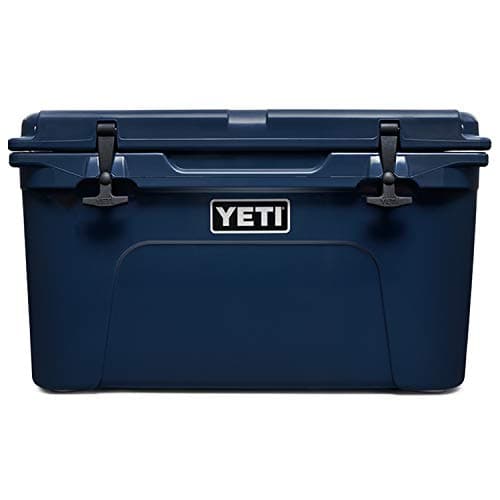
A rotomolded cooler is one whose body is made by rotational moulding - polyethylene powder is tumbled inside a heated mould spinning on two axes until it coats the interior in a single seamless wall of even thickness. That construction has no seams to split and no laminated layers to separate, which is why the failure points on a rotomolded cooler are all bolt-on hardware: latches, hinge pins, handles and the drain plug. If you want a cooler for the next twenty years, that is the whole reason to buy one, and the YETI Tundra 45 is the best-built example.
How the process works, and why it matters
The mould is loaded with plastic powder, closed, heated, and rotated on two axes at once. The powder melts and is thrown against every interior surface, building up a wall of consistent thickness including in the corners - which is exactly where other moulding methods go thin. The mould is then cooled while still turning so the wall sets evenly.
Two consequences follow, and they are the whole value proposition:
- No seams. The body is a single piece. There is no join along the base or the lid lip to open up, which is the most common catastrophic failure on a cheap cooler.
- Even, thick walls. Uniform thickness means the box is stiff enough to stand on and to hold pressure-injected insulation without flexing. Stiffness is also why the gasket can seal properly, and the seal is most of the ice retention.
Rotomolded versus blow-molded
Blow moulding - the process behind almost every cooler sold before about 2010 and most cheap ones today - inflates a parison of molten plastic against the inside of a mould with air pressure. It is fast and cheap and produces a thin hollow wall, which is then filled with foam insulation.
A blow-molded cooler is lighter, far cheaper and perfectly adequate for a day at a beach. Its walls flex, its insulation is thinner, its lid seal is looser, and the usual lifespan ends when a hinge tears out of a thin wall or the lid warps enough to stop sealing. The Igloo BMX here is the best version of that idea: blow-molded with a steel-reinforced base, a three-year warranty on the Super Tough range, a fraction of the price and roughly half the ice life.
What the warranties actually say
This is the part the price tag implies and the document contradicts. None of these coolers carries a lifetime warranty.
- YETI: five years on hard coolers.
- RTIC: five years on Ultra-Tough hard coolers, three years on Ultra-Light hard coolers, one year on soft-sided coolers.
- Igloo: one year on most hard and soft coolers, three years on Super Tough models, five on Rotomold and IMX models.
So YETI and RTIC publish the same term. If you were paying the YETI premium for the warranty, you were paying for something you can have for considerably less - which is the argument our YETI versus RTIC comparison works through in detail.
The parts are the point
What makes a rotomolded cooler a buy-it-for-life object is not the warranty, it is the parts list. On the Tundra, the latches, hinge pins, handles and drain plug are all sold as replacement parts, and those are exactly the components that fail. A rubber T-latch perishes in UV after years of use; it costs a few pounds and takes a screwdriver.
RTIC publishes replaceable latches and drain hardware for the same reason. The Igloo does not - it is replace-on-failure, which is not a defect in a cooler at that price, just a fact to price in.
What a rotomolded cooler does not buy you
- A week of ice by default. Ice retention is mostly how you pack it: pre-chill the box, use block ice with cubes around it, fill it to capacity, and keep it out of the sun. Our cooler packing guide covers the order that actually works.
- A light cooler. Thick even walls weigh a lot. A loaded 45-quart rotomolded cooler is a two-person lift, and that is the single most common regret.
- Value for occasional use. For two trips a year, a blow-molded cooler is the right answer and spending four times as much is not durability, it is just spending.
Who should buy one
Buy rotomolded if the cooler lives in a truck, a boat or a garage and gets used through the season; if you need ice to survive more than two days; or if you want the version you can keep repairing. Buy blow-molded if the cooler comes out for a barbecue and goes back in the loft - and read our coolers that last roundup for the full ladder including the wheeled options.
The other things rotomoulding is used for
It helps to know that this is not a cooler technology. Rotational moulding is how kayaks, water tanks, playground equipment, livestock troughs and road barriers are made - anything that needs to be a large, seamless, impact-tolerant hollow plastic shape.
That lineage tells you what the process is good at and what it costs. It produces thick, stress-free, seamless walls with excellent impact resistance, and it is slow and energy-intensive per unit, which is why rotomolded goods are expensive relative to their material cost. It also explains the weight: there is no way to make the wall thin without losing the uniformity that is the whole point.
So when a cooler is described as rotomolded, the claim being made is specifically about the shell - not the insulation, not the gasket, not the latches. The insulation is a separate pressure-injected foam and the hardware is bolted on. Judge those parts separately, because they are the parts that will actually need attention.