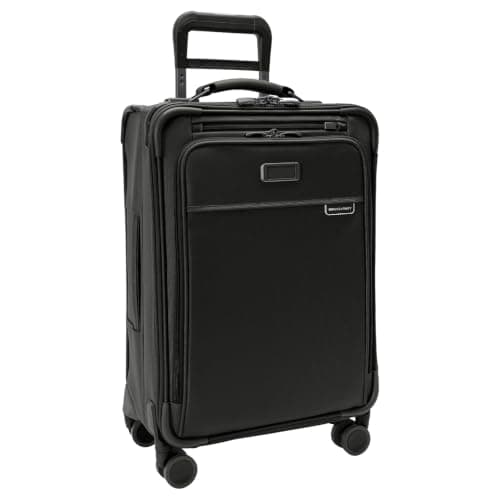
If you fly more than a few times a year, buy the Briggs & Riley Baseline: the Simple As That guarantee covers the repair of every functional aspect of the bag for life at no charge, and it explicitly includes damage caused by airlines. Travelpro’s Built For A Lifetime warranty is narrower - defects in materials and workmanship, specifically including wheels, zips and handles - but it covers the parts that actually break, and the price gap between the two is far wider than the cover gap.
The two guarantees, in their own words
Briggs & Riley - Simple As That. Covers the repair of all functional aspects of the bag for life at no charge. It does not cover cosmetic wear, cleaning due to odours or stains, or replacement of lost or stolen bags or their contents. The remedy is repair, not replacement.
Travelpro - Built For A Lifetime Limited Warranty. On its core collections, covers defects in materials and workmanship, specifically including wheels, zippers, extension handles and carrying handles.
The difference is one clause and it is the whole comparison. Travelpro covers the bag being badly made. Briggs & Riley covers the bag being broken. Since a suitcase is almost never killed by a manufacturing defect and very often killed by a baggage system, that clause is worth real money to a frequent flyer and close to nothing to someone who takes one holiday a year.
Repair versus replacement, again
This distinction runs through every category on this site and luggage is where it is clearest. Briggs & Riley’s guarantee is a repair program: a wheel is replaced, a handle is rebuilt, a zip is re-run, and a six-year-old bag comes back as a six-year-old bag that works.
Replacement-based policies have a structural problem - the company has to decide whether your damage qualifies, and the more valuable the remedy the stricter that decision becomes. A repair program has no such incentive, because fixing a wheel is cheap. Travelpro also runs a repair network and serviceable wheels and handles, which is why it is the second pick rather than a distant one.
The bags themselves
Both carry-ons here are ballistic nylon over an aluminium frame or handle system, which is the right construction for a bag that will be thrown. Nylon absorbs impact and abrades; a hardshell cracks.
The Baseline’s distinguishing feature is the outside frame handle system, which puts the handle tubes on the exterior of the case and gives you a completely flat interior. That is a genuine packing advantage and it is also the part most likely to be bent by a baggage handler - which is precisely what the guarantee exists for.
The Platinum Elite uses magnetic spinner wheels and an aluminium handle, and the wheels are the single most replaced part on any spinner bag. Travelpro naming them in the warranty is a sign the company knows exactly what fails.
The honest third option
The Samsonite Freeform is a polypropylene hardshell with a 10-year warranty against manufacturing defects in craftsmanship or materials - Samsonite publishes three-, five- or ten-year terms depending on model. Accidents and misuse are excluded.
Ten years is a real number and not a lifetime one, and the bag is light and cheap. It is the sensible choice if you fly rarely, want a hardshell, and would rather own a bag for a decade than forever. Hardshell cracks are generally replacement cases rather than repairs, so the repair logic above does not apply to it.
Who should buy which
- Fly monthly or more: Briggs & Riley. The airline-damage clause will be used, probably more than once, and the bag will outlast several of the alternatives.
- Fly a few times a year: Travelpro Platinum Elite. The parts that break are covered for life, the construction is the same family, and the money saved is substantial.
- Fly once or twice a year: the Samsonite hardside, and accept that it is a ten-year bag.
What to do before you need the guarantee
- Register the bag and keep the proof of purchase as a file, not a receipt. Over a lifetime guarantee a till receipt is worthless - it fades to blank within a decade.
- Photograph the bag intact, once, when it is new. A damage claim goes faster when the before picture exists.
- Report airline damage at the airport before you leave the baggage hall, even if the bag is covered for life. The two claims are separate and the airline one expires fast.
- Send it for repair while the fault is small. A dragging wheel ruins a wheel housing, which is a bigger job than a wheel.
Our luggage roundup ranks these three alongside the carry-on backpack option, and brands with true lifetime warranties puts Simple As That next to the strongest wording in every other category.
What actually breaks on a suitcase
Four things, in order of how often we see them named in warranty documents - which is a reasonable proxy for how often they fail.
- Wheels. The single most common failure on any spinner. A worn wheel runs out of true, then chews its housing, then the housing cracks. Travelpro naming wheels in its warranty is not marketing, it is actuarial.
- Zip sliders. The slider wears before the teeth do, which is why a zip that will not close is usually a slider replacement rather than a new zip.
- Telescoping handles. Bent by being used to drag a bag over a kerb, or by a baggage belt. On an outside-frame design like the Baseline the tubes are exposed, which makes them more vulnerable and far easier to replace.
- The shell or fabric. Nylon abrades and can be patched; polypropylene cracks and generally cannot.
Three of those four are component swaps. A guarantee that pays for component swaps for life is therefore worth far more than the headline word “lifetime” implies on its own, and that is the real reason the Briggs & Riley wording leads this page.