Head to head
The Right Leash for a Dog That Pulls
What equipment genuinely helps with a puller, and the honest limit of what gear can do.
Pets
This is the one category on the site where our answer is that nothing is worth buying. Here is the mechanism, and what to use instead.
We do not recommend a retractable leash at any price, and there are no product picks on this page. That is a deliberate decision and it costs us the commission we would earn from a category people search for constantly.
We would rather lose it than send a reader toward something we think is a bad idea.
A retractable leash is a thin cord or tape on a spring-loaded spool with a thumb brake. Four things follow from that design and none of them is a quality problem:
1. The cord frays where it enters the housing. That is the point of maximum flex and abrasion, it is inside the case where you cannot inspect it, and it is where the lead eventually parts - usually at full extension, under load, which is the worst possible moment.
2. The brake is the first mechanism to go. It is a small plastic part under repeated impact load. When it fails, it fails without warning and you have no control at all.
3. There is constant tension on the dog. The spring pulls back the whole time, which teaches the dog that leaning into the lead is normal and that pulling extends it. It is the precise opposite of loose-lead training.
4. The thin cord concentrates force. A thin line running across skin at speed causes burns and lacerations that flat webbing does not. Hand and finger injuries from grabbing a running line are the most commonly reported type.
A better-made retractable fixes none of those. They are properties of the design.
A dog twenty feet ahead on a thin line is a dog you cannot recall in time at a curb, cannot pull back from another dog, and cannot stop reaching a cyclist. The lead itself becomes a trip hazard at ankle height that other people genuinely do not see.
And a dog that reaches the end of an extended line at speed takes the full deceleration through its neck, which on a flat collar is a serious impact.
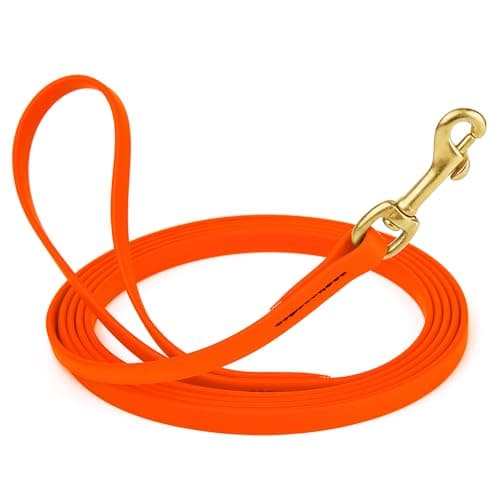
A long line. Fifteen to thirty feet of biothane or webbing, clipped to a harness. It gives the dog more freedom than a retractable, not less. It costs under twenty dollars. It has no mechanism, no spring and no brake, so there is nothing to fail. It applies no constant tension, so it does not teach pulling. And you can hold it, stand on it, or let it trail.
Our leash roundup covers the long-line options, and the biothane page explains why the coated material is the right one for a line dragged through wet grass.
Actual recall training. The thing people buy a retractable to avoid. A long line is the standard tool for teaching it, which is a neat coincidence.
A small, calm dog, in a wide open space, with no other dogs, cyclists or roads within reach. Under those conditions the hazards mostly do not apply.
A long line also works perfectly under those conditions, costs less, lasts longer and does not train the wrong behavior. So the narrow case is not actually an argument for the product - it is an argument that it does not do much harm in a car park.
Because a site that only ever says “buy this one” is not a site that is telling you anything. Sometimes the correct recommendation is that an entire category is a bad idea, and the only way to make that credible is to publish it on the pages where the commission would be.
FAQ
They are associated with a specific set of injuries to handlers and dogs: rope burns and lacerations from the thin cord, finger injuries from grabbing a running line, and impact injuries when a dog reaches the end at speed. The thin cord concentrates force in a way flat webbing does not.
The spring, the brake and the cord housing are all wear parts and all fail, and we found no brand that publishes a meaningful warranty on the mechanism. More importantly, the training problem is not a durability problem - a perfectly reliable retractable still teaches the wrong lesson.
A long line - 15 to 30 feet of biothane or webbing. It gives the dog more freedom than a retractable, costs less, has no mechanism to fail, and does not teach the dog that pulling extends the lead.
In a wide open space with a small, calm dog and no other dogs, cyclists or roads nearby, the risk is low. That is a narrow set of conditions, and a long line does the same job better in all of them.
Read next
Head to head
What equipment genuinely helps with a puller, and the honest limit of what gear can do.
Best durable dog leashes
Leash materials compared on what each one does wrong, plus the hardware nobody checks.
Best biothane leashes
What biothane is, why it beats leather in wet conditions, and which hardware to insist on.