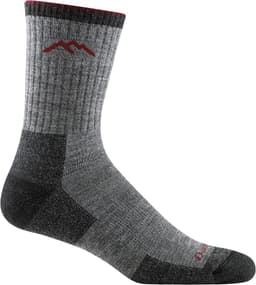
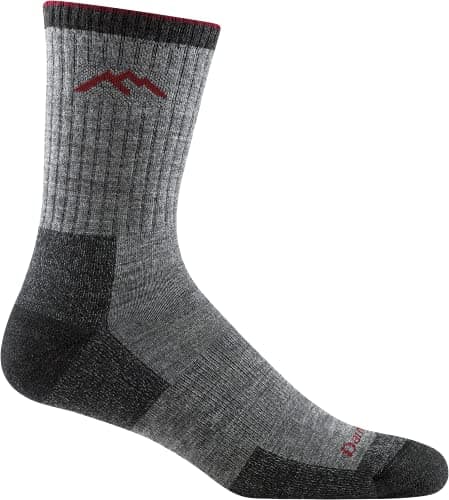
Buy the Darn Tough Hiker Midweight Micro Crew, because it is the only sock here that somebody has promised to replace when you wear it out. Darn Tough’s Unconditional Lifetime Guarantee covers wearing a hole in the sock - including threadbare spots from normal wear and tear - with no receipt required and, in the company’s words, no fine print. Every other sock on this page is sold as a consumable. That single row in the comparison table is the whole argument.
The blend, not the wool percentage
Hiking sock marketing pushes merino content as though more is better. It is not, past a point. Merino does three things well: it moves moisture, it insulates when damp, and it resists odour so you can wear a pair for two days. What it does badly is resist abrasion, which is exactly what a sock inside a boot is subjected to for eight hours.
So every good hiking sock is a blend. Nylon takes the wear at the heel and toe, a few percent of Lycra or elastane keeps the sock from bunching, and merino does the comfort work. The People Socks entry here runs 71% merino - the highest wool content on the page - and the honest consequence, stated in its own registry entry, is faster wear-through than a nylon-heavier blend. More wool is a comfort choice with a durability cost, not an upgrade.
Darn Tough Hiker - the benchmark
Merino, nylon and Lycra, seamless toe, knit in Northfield, Vermont. It is comfortable, it does not stink after two days, and the fit is good for most feet without being outstanding for any.
The guarantee is why it wins. Not “lifetime against defects” - which is what almost every brand means - but explicitly covering wearing a hole in the sock through normal use, with no proof of purchase. The price is three to four times a supermarket wool sock, and the claim goes through a form and a credit rather than an instant swap, which is a real friction worth knowing about. It is still the only sock in this category where the arithmetic of buying once genuinely works. We make the full case on is Darn Tough worth it.
Smartwool Hike Classic - the better fit, the worse promise
For a lot of feet the Smartwool shaping is a genuine step above Darn Tough, the Indestructawool knit is more durable than Smartwool’s older socks, and it comes in more sizes and colours.
Smartwool publishes a two-year warranty. Darn Tough publishes forever. If you buy socks once, that one row decides it - and we say so on Darn Tough vs Smartwool rather than hedging. Buy the Smartwool if the Darn Tough does not fit your foot, which is a legitimate and common reason, and accept that you are buying a two-year sock.
Wigwam Merino Comfort Hiker - American-made middle ground
Knit in Sheboygan, Wisconsin, at a price between the budget synthetics and the two premium names, with comfortable medium cushioning.
Wigwam’s guarantee covers defects in materials and workmanship only, and requires proof of purchase and a return form - which is the ordinary industry standard that Darn Tough has made look mean. The knit is thinner than the premium socks and the sizing is less consistent. For a sock you will wear twice a month rather than daily, none of that matters much.
People Socks 71% Merino - the most wool for the money
The highest merino percentage here, made in the USA, sold in four-packs that undercut single-pair premium pricing by a wide margin.
There are no published warranty terms we could find, the sizing runs large, and the high wool content means faster wear-through. You are buying wool content rather than a promise, and if what you want is warm, comfortable socks at a price where replacing them is not an event, that is a perfectly rational trade.
Darn Tough Boot Midweight Hunting - for standing still in the cold
The heaviest cushioning of Darn Tough’s boot socks, in a tall boot height, under the same unconditional guarantee. For cold-weather hiking, hunting, or anything that involves being stationary in low temperatures, this is the right sock on the page.
It is too warm for anything else, and the bulk changes boot fit noticeably - which is a real problem if you bought your boots to fit a midweight sock. Size the boot and the sock together or not at all.
What actually kills hiking socks
Not hiking. Washing and drying, mostly. High heat felts merino and destroys the elastane that holds the sock’s shape, and fabric softener coats the fibres and ruins the wicking that you paid for.
Wash cool or warm, inside out, no softener, and either line dry or tumble on low. A sock treated that way lasts years; the same sock run hot a dozen times goes baggy and thin in a season, and no guarantee covers “I shrank them”. The full routine is on how to wash merino wool socks, and socks with a lifetime warranty covers which brands genuinely honour a worn-out sock.
Blisters are a fit problem, not a sock problem
A sock can make a blister less likely, but it cannot fix a boot that is moving against your foot. If you are getting blisters in the same place every walk, the order to work through is lacing, then sock thickness, then the boot - not a more expensive sock.
Two specifics worth more than any product. A heel-lock lacing pattern through the top two eyelets takes the heel lift out of most boots immediately, and heel lift is what causes heel blisters. And a single sock, properly fitted, beats two thin socks in almost every case: two layers move against each other and generate exactly the friction you were trying to remove. If the boot itself is the problem, how to break in boots covers what is fixable and what means sending them back.