The best pocket knife under $100 is the Buck 110 Folding Hunter, because Buck's Forever Warranty runs for the life of the knife and Buck repairs rather than credits. That is the whole argument in one sentence, and it is deliberately not about steel. Four of the five knives on this page publish a lifetime term and have a real service path behind it, which is what separates a knife you will still be carrying in twenty years from one you will replace twice.
What under $100 actually buys in a folding knife
This is a good bracket, and it is good for an unglamorous reason: it is the first price point where the whole category is serviceable. Below about twenty dollars you are mostly buying riveted construction - a knife assembled in a way that cannot be taken apart, so a loose pivot or a worn detent is terminal. Above a hundred you are buying better steel, tighter machining and lighter materials, which are real improvements that do not change the working life much.
In between sits a set of knives where the parts are screwed rather than peened, the maker publishes a term, and somebody will sharpen it for you. That is the entire proposition of this page.
The three questions, applied to folders
1. Can it be taken apart and put back together? A screwed-together folder with a back lock or a liner lock can be stripped, cleaned, re-lubricated and reassembled by the owner. A pinned folder cannot. This matters far more than it sounds: pocket knives fail at the pivot, from grit, long before the blade wears out.
2. What does the published warranty say, and what does it exclude? Every term on this page excludes the same things - prying, abuse, normal wear, sharpening damage - and every one of them says so in writing. The differences are in the remedy.
3. What is it made of, and where? Blade steel, handle material and country of manufacture are published for all five, which is not true of the category generally.
Buck 110 - the paperwork and the pattern
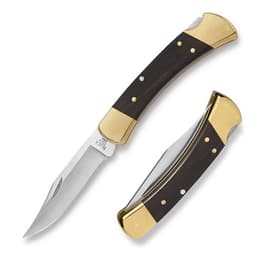
The 110 is the folding lockback that defined the shape, and it is made in Post Falls, Idaho. Brass bolsters, ebony handle, a 420HC blade and a leather sheath. Buck's Forever Warranty warrants each knife free of defects in material and workmanship for the life of the knife, and the remedy is repair or replacement of a defective knife - not a store credit, which is how several competitors discharge the same promise.
The honest cons are real and worth knowing before you buy. It is heavy - brass and ebony are not pocket-friendly materials, and this is a belt-sheath knife far more than a jeans-pocket knife. It is a two-hand opening in its classic form, with a nail nick rather than a thumb stud. And 420HC is a softer steel that will not hold an edge as long as the Spyderco's VG-10. That last one is a genuine trade rather than a flaw: it also means you can put a shaving edge back on it in a couple of minutes on a basic stone, which for a working knife is often the better property.
Spyderco Delica 4 - the one to actually carry
If the Buck is the knife to own, the Delica is the knife to have in your pocket on a Tuesday. Fiberglass-reinforced nylon scales, a VG-10 blade, a back lock and a four-position clip, made in Seki, Japan. It weighs a fraction of the Buck and opens one-handed off the round hole. Spyderco warrants it against defects in material and workmanship for the life of the product with its published exclusions, and because it is screwed together, the scales, clip and hardware are owner-serviceable.
Cons: the FRN scales flex under hard lateral load in a way the Buck's brass and ebony do not, so this is a slicer rather than a pry bar. VG-10 takes real work to resharpen once it is properly dull - the edge-holding you are paying for cuts both ways. And the back lock needs two hands to close safely, which some people find a step backwards from a liner lock.
Victorinox - two knives, one guarantee
The Cadet Alox is the flat one. Ribbed aluminum scales instead of plastic, a blade, a nail file, a can opener and two screwdrivers, and a profile thin enough that it genuinely disappears in a front pocket with keys. The Huntsman is the thicker, more capable layout - adds a saw, scissors, corkscrew and an awl - and is the one to buy if the knife is also your toolkit.
Both are made in Switzerland and both carry Victorinox's lifetime guarantee against defects in material and workmanship, with factory service behind it.
Cons, and they are the same for both: neither blade locks in the standard models, which rules them out for any task where a closing blade would be dangerous. The steel is soft by modern standards - easy to sharpen, quick to dull. And on the Huntsman specifically, the thickness is the price of the tool count; it is a noticeably bulkier object than the Cadet for jobs where you only ever use the blade.
Opinel No. 08 - the budget pick, and a serious knife
The Opinel is the cheapest knife here by a wide margin and it is not a compromise choice. An XC90 carbon steel blade, a beechwood handle, and the Virobloc collar that locks the blade open or shut. Made in Savoie, France, to a pattern that has barely changed in over a century. Opinel publishes a lifetime warranty with exchange in case of defects in materials and workmanship, excluding normal wear, impact and misuse.
It is also the most repairable object on this page: a pivot, a blade, a wooden handle and a steel ring. Every one of those can be replaced, reshaped or re-pinned with hand tools.
Cons, stated plainly. Carbon steel rusts - put it away wet once and you will have spots by morning, and it will patina regardless, which some people like and some do not. The beech handle swells when it gets soaked, which can make the blade stiff to open until it dries. And there is no pocket clip, so this rides loose in a pocket or a bag.
Locks, and what each one means for the life of the knife
Three mechanisms appear on this page and they age very differently.
The back lock on the Buck and the Delica puts a spring-loaded bar into a notch in the blade tang. It is strong against the forces a folder actually sees, it wears slowly and predictably, and when it does develop play the fix is usually tightening the pivot rather than replacing anything. It also needs two hands to close safely, which is the price.
The slip joint on the Victorinox knives does not lock at all - a spring holds the blade open under tension. That rules it out for any task where the blade closing on your fingers would be serious, and it is the reason these are legal to carry in places where locking knives are not. The upside for longevity is that there is almost nothing to fail: a flat spring and a pivot, both of which Victorinox will service.
The Virobloc collar on the Opinel is a rotating steel ring that can lock the blade open or, usefully, locked shut in a pocket. It is the simplest locking mechanism in production and it is field-serviceable with no tools at all - if it loosens you can gently squeeze it back to tension.
None of these is better than the others in the abstract. A locking knife is safer for cutting toward yourself; a non-locking one is carryable in more places. Decide which problem you have before you decide on steel.
Sharpening, by steel
This is the maintenance that decides whether a knife stays in service, and the three steels here want different things.
420HC (the Buck) is the softest and the friendliest. A basic medium stone and a few minutes brings it back from genuinely dull, and a ceramic rod keeps it going for weeks between proper sharpenings. If you have never sharpened a knife, this is the steel to learn on.
VG-10 (the Delica) holds an edge several times longer and asks for more in return. Once it is properly blunt you want a diamond or a quality ceramic stone and some patience; a cheap pull-through sharpener will take material off without ever giving you a clean edge. The right routine is to strop it often and sharpen it rarely.
XC90 carbon steel (the Opinel) takes the keenest edge of the three and takes it fastest. It also oxidizes, and it should - a stable dark patina forms over the first months and then protects the steel underneath. Wipe it dry, keep a trace of oil on it, and do not store it wet or in a leather sheath.
What to avoid in this bracket
Three things, all of which are easy to spot before you buy.
Riveted construction. If the pivot is peened over rather than screwed, the knife cannot be opened for cleaning and a gritty pivot is permanent. Look for visible hardware on the scales.
No published warranty and no service address. Plenty of knives in this price range carry neither. That is not automatically a bad knife, but it does mean the knife’s working life ends at its first real problem, which changes the arithmetic against anything on this page.
Assisted-opening mechanisms on a budget. A torsion bar or spring is one more part that can fail, and in this bracket it is usually the part that does. A well-tuned manual pivot on a bearing or a washer will open just as fast after a decade.
Carry, legality and the practical size question
Blade length rules vary by state and by city, and several places distinguish between locking and non-locking knives rather than by length. That is worth ten minutes of checking against where you actually live and work before buying, because it is the one factor on this page that can make an otherwise ideal knife the wrong purchase.
On size: the practical ceiling for a knife you will carry every day without thinking about it is somewhere around three inches of blade and four ounces of weight. The Cadet and the Delica sit comfortably inside that; the Buck sits well outside it, which is why it comes with a belt sheath and why this page recommends it as the knife to own rather than the knife to pocket.
How to choose between them
Buy the Buck if the knife lives on a belt and you want the strongest published remedy in the bracket. Buy the Delica if it lives in a pocket and gets used daily. Buy the Cadet if you want to forget it is there, the Huntsman if the knife is doing a toolkit's job, and the Opinel if you want the most knife for the least money and do not mind drying it.
All five will outlast the decade if you keep grit out of the pivot and oil on the steel. None of them will survive being used as a pry bar, and every one of those warranties says so in its exclusions.
For the field above this price bracket, our pocket knives that last roundup adds the Benchmade and Spyderco flagships, and Benchmade vs Spyderco settles the warranty question between the two. If you want tools rather than a blade, multitools that last covers the Leatherman and Victorinox side by side.