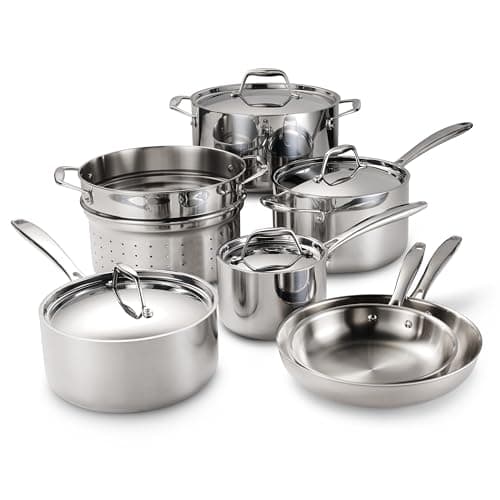
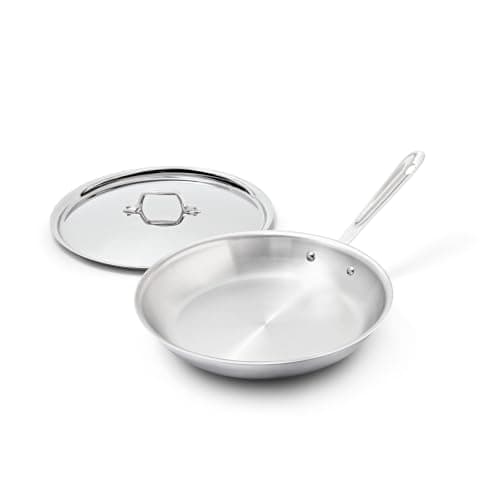
All-Clad D3 is worth it if you are buying the last frying pan you will own: bonded stainless with no coating has nothing that wears out, it is made in the USA, and the lifetime warranty covers defects in material, construction and workmanship. The honest qualifier is that the construction itself - three-ply bonded stainless - is not exclusive, and Tramontina’s version carries a lifetime warranty of the same class for considerably less money.
Why uncoated stainless is the real buy-it-for-life cookware
Every non-stick pan is a consumable. The coating is the functional surface and it degrades, which is why non-stick warranties are measured in years and why a non-stick pan is a thing you re-buy. Enamelled cast iron is a glass coating, which cannot be repaired when it chips.
Bonded stainless has no coating at all. The cooking surface is the metal, and the only failure modes are mechanical: a loosened rivet, a warp from thermal shock, or a rare delamination of the bonded layers. That is a very short list, and the first and third are exactly what a lifetime defect warranty is for. It is the only mainstream cookware category where the phrase buy it for life is structurally true rather than aspirational.
What three-ply actually means
A D3 pan is three bonded layers: stainless on the cooking surface, an aluminium core, and stainless on the outside. The aluminium does the heat conduction - steel is a poor conductor - and the steel does the durability and the induction compatibility.
Two things follow. First, more plies is not automatically better: five-ply pans like the Demeyere Industry or the Heritage Steel Titanium series add thermal mass and evenness and also add weight and cost. Second, the quality question in three-ply is whether the cladding runs all the way up the walls and to the rim, or stops at a disc on the base. Full cladding is what stops a sauce scorching at the waterline, and it is where All-Clad is consistently good.
Where All-Clad earns it
- Made in the USA. D3 is manufactured domestically, which on this site is a fact we can check and publish rather than a marketing line.
- Cladding consistency. Even, full-wall bonding on every piece we have looked at, which is the main thing that varies between brands at this construction.
- Handle geometry. The long stainless handle stays cool on a hob and is oven-safe without a caveat. It is also the most-complained-about feature, because it is not comfortable - that is a genuine trade, not a defect.
- Parts and continuity. The D3 line has barely changed in decades, so a lid you buy today fits a pan from years ago. Continuity is an underrated durability feature.
Where it does not
Against Tramontina Tri-Ply Clad, the construction is the same idea and the warranty wording - free from defects in material and workmanship for the lifetime of the original purchaser - is as strong. The finish is less refined and the handles are less considered. For a first proper set, it is the rational buy, and we say so on our All-Clad versus Tramontina comparison.
Against Heritage Steel, you are trading three plies for five and a 316Ti cooking surface, also American-made, also under a published lifetime warranty. If you want the most corrosion-resistant cooking surface available in a domestic pan, this is it.
Against Demeyere, the Industry five-ply is the better-engineered pan - handle-free rivets inside, silvinox surface treatment - at a higher price and a notable weight penalty.
Sets versus pieces
A ten-piece set is almost always two or three pieces you will use constantly and several you will not. If budget is the constraint, buy a 12-inch fry pan and a 3-quart saucier in good bonded stainless and leave the rest of the kitchen in cast iron and carbon steel, which do different jobs better anyway.
If you are furnishing a kitchen from nothing, a set is the cheaper route per piece and the Tramontina set is where the value sits. Our stainless cookware roundup ranks the sets against each other on cladding and warranty.
How to not ruin it
- Never run cold water into a hot empty pan. Thermal shock is the one thing that reliably warps bonded stainless, and warping is not a warranty claim.
- Preheat properly and add fat when the pan is hot, not before. Food sticking to stainless is almost always a temperature problem, not a pan problem.
- Use a stainless scourer or a dedicated cleaner on burnt-on residue. There is no coating to protect, so the surface can take abrasion that would destroy any other pan.
- Expect discolouration. A blue-brown heat tint on the base is normal, cosmetic and not covered by any warranty anywhere.
The verdict
Worth it as a one-off purchase of a pan you will own for life, and the American manufacturing and cladding consistency are the reasons - not the warranty, which the cheaper brands match on paper. If you are buying a whole set on a budget, buy Tramontina and do not feel short-changed.
What a lifetime warranty on cookware is actually for
It is worth being precise about this, because the phrase does a lot of unearned work in this category. A cookware lifetime warranty covers the pan being wrong when it was made: delamination of the bonded layers, a rivet set badly, a handle that was never properly attached. Those faults are rare and they show up early.
What it does not cover is anything you do to the pan afterwards. Warping from thermal shock, discolouration from heat, pitting from salt left sitting in a wet pan, a scorched base from an empty preheat - none of those is a defect, and no brand pays for them. That is reasonable, and it means the warranty is not the thing keeping your pan alive.
The thing keeping it alive is that there is nothing on it to wear out. That is why uncoated bonded stainless belongs on a buy-it-for-life site and non-stick does not, and it is true of the cheap tri-ply as much as the expensive kind. Our cookware with lifetime warranties page sets out which brands publish which wording, including the exclusions.