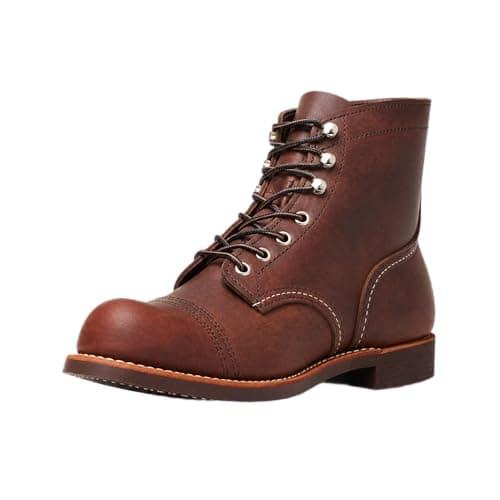
Red Wing is worth it if - and only if - you intend to have the boots resoled. The warranty is twelve months against defects, which is ordinary. What is not ordinary is that the boots are Goodyear welted, made in Minnesota from the company’s own leather, and Red Wing runs its own repair shop at the factory. That turns the sole into a consumable and the boot into something you keep. Take the resole out of the equation and the premium stops making sense.
What you are actually buying
Three things, in descending order of importance.
- The welt. The sole is stitched to a welt rather than glued to the upper, so it can be cut off and a new one stitched on without touching the leather above it. This is the only feature on the boot that decides whether it is still a boot in 2040.
- The leather. Amber Harness and Oro Legacy are thick, oil-rich full-grain hides from Red Wing’s own tannery. Thick leather creases rather than cracks, and it is the reason a ten-year-old pair looks deliberate instead of tired.
- The repair path. Red Wing operates a repair shop at the Red Wing, Minnesota factory and its stores take resoles with original parts. A cobbler can do the same job; what the factory adds is original soles and no argument about it.
What you are not buying: a lifetime warranty
This is where the brand gets credited with something it does not publish. The Heritage warranty is twelve months against defects in workmanship and materials, original purchaser only, original receipt required, with failures from excessive or abusive wear excluded.
That is a normal footwear warranty. It is not a durability promise, and it is not what makes these boots last. We point this out because the whole point of this site is reading the document rather than the marketing, and on this specific question the internet is confidently wrong in Red Wing’s favour.
The resole math, without invented numbers
We do not publish prices on this page - live prices are on the buy buttons, where they come from Amazon rather than from us - so here is the structure of the sum rather than made-up figures.
A cemented boot has one life. When the sole wears through, the boot is finished, and your cost is the full purchase price divided by however many years that took. A welted boot has as many lives as the upper survives, and each extra life costs a resole rather than a boot. The premium you pay at the counter is the entry fee to that second structure. If you resole once, the premium is usually repaid; if you resole twice, it is not close.
The corollary is the honest part: if you are the kind of person who will not take boots to a cobbler, this premium buys you a nicer boot and nothing else. There is no shame in that, but it changes the answer, and a cheaper cemented boot replaced on a schedule is a perfectly rational way to live.
Where Red Wing is genuinely beaten
On price, by Thorogood
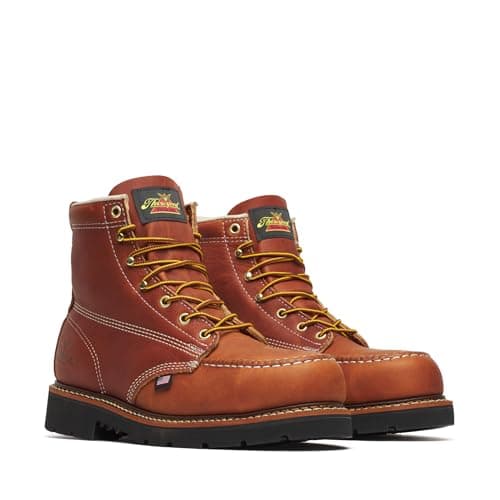
The American Heritage moc toe is union-made in Wisconsin, Goodyear storm welted and carries a steel toe, for substantially less. It publishes no warranty terms we could find and it has no factory repair shop - but the welt is a welt, and a cobbler does not care whose name is on the boot. If value-per-welt is the metric, Thorogood wins outright.
On entry price, by Thursday
The Captain is Goodyear welted at roughly half the price of a US-made boot. The leather is thinner and creases sooner and deeper, the rubber outsole is cemented to the welt on some makes which complicates the first resole, and there are no published warranty terms. But the construction logic is the same idea, and for a first welted boot that is enough.
On comfort, by its own cheaper sibling
If the Iron Ranger’s break-in is what is putting you off, the answer inside the range is the Classic Moc 875 on the crepe wedge, or the Blacksmith with its single leather toe. Both are the same welt, the same factory and the same repair path with far less of the first month.
The three cases where it is not worth it
- You need a safety toe. The Heritage line has no safety toe option. Buy Thorogood, Danner or Chippewa instead - all three are welted and all three are rated.
- Your job is wet and rough. Heritage boots are not waterproof boots. A membrane-lined, lugged, steel-toed boot is the right tool and the Iron Ranger is not it.
- You will never resole. Covered above, and it is the most common case by a wide margin.
Sizing, because it is the most common complaint
Red Wing Heritage boots are built on the company’s own lasts and most people drop about half a size from their sneaker size. A boot bought in the wrong size does not break in, it just hurts in a slightly different place each month - and the resole path is worthless on a boot you do not wear. Try them on late in the day with the socks you will actually use.
The verdict
Worth it, with conditions. Buy a Red Wing Heritage boot if you want a boot you will keep, you have a cobbler or a Red Wing store you can reach, and you accept that the warranty is twelve months and irrelevant. Buy the Thorogood if the same construction at a lower price is the priority, and the Thursday if the entry price is the barrier. Our Iron Ranger review goes deeper on the specific boot, and how long Red Wings last sets out the service life you can reasonably expect.